

Indian Journal of Health Social Work
(UGC CARE List Journal)
CAREGIVER BURDEN AND ASSOCIATED SOCIO-DEMOGRAPHIC
FACTORS AMONG FAMILY CAREGIVERS OF INDIVIDUALS WITH
SEVERE MENTAL ILLNESS
Upendra Singh¹ & Tushti Bhardwaj²
1Ph.D Scholar, Delhi School of Social Work, University of Delhi, 2Professor, Department of
Social Work, Dr. Bhim Rao Ambedkar College, University of Delhi, Delhi, India
Correspondence: Upendra Singh, e-mail: upendrasingh.aims@gmail.com
ABSTRACT
Background: Family caregivers are central to the care of individuals with severe psychiatric
disorders, particularly in low-resource settings. The chronic and relapsing nature of these illnesses
often imposes a significant burden on caregivers, impacting their emotional, physical, social,
and financial well-being.Aim: This study aimed to assess the burden experienced by family
caregivers of individuals with severe psychiatric disorders and examine its association with key
socio-demographic variables.Methodology: A cross-sectional descriptive study was conducted
at the Department of Psychiatry, ABVIMS & Dr. RML Hospital, New Delhi. A total of 100 caregivers
were recruited through convenience sampling. Data were collected using a socio-demographic
datasheet and the Family Burden Interview Schedule (FBIS), and inferential statistics (ANOVA,
linear regression) were employed.Results:Caregivers reported moderate to high levels of burden,
with the highest scores in the domains of mental health impact, routine disruption, and family
interaction. The overall mean burden score was 15.9 ± 3.9, indicating a considerable level of
caregiver burden in the study sample. Linear regression analysis revealed that caregiver age,
gender, educational level, employment status, and duration of caregiving were significantly
associated with burden scores (p < 0.05).Conclusion: The findings highlight the pervasive burden
faced by caregivers and underscore the need for caregiver-centred mental health policies and
psychosocial interventions. Tailored support strategies based on socio-demographic risk factors
are essential to reduce distress and improve care outcomes.
Keywords: Caregiver burden, psychiatric illness, schizophrenia, bipolar disorder, socio
demographic correlates, mental health services, family support.
Submitted: 10.01.2026 Revised: 15.03.2026 Accepted: 10.06.2026 Published: 30.07.2026
How to cite this article: Singh, U. & Bhardwaj, T. (2026). Caregiver Burden and Associated
Socio-Demegraphic Factors Among Family Caregivers of Individuals with Severe Mental Illness.
Indian Journal of Health Social Work, 8(1), 46-54.
INTRODUCTION
Family caregivers play a crucial role in
sustaining treatment adherence, ensuring
safety, and promoting recovery in individuals
with severe mental illnesses such as schizophrenia, bipolar disorder, and major
psychosis. In India and similar Low Middle
Income Countries, where mental health
i nfrastructure is overstretched and
underfunded, families are often the sole
caregivers, filling critical service gaps (Kohn
et al., 2004).
Caregiving under these conditions comes at
a significant personal cost. Chronic caregiving
is known to cause physical exhaustion,
emotional fatigue, financial strain, and social
i solation (Chadda, 2014). Caregivers
frequently report experiencing symptoms of
anxiety, depression, and burnout, a
phenomenon now recognized as “caregiver
burden” (Zarit et al., 1980). Despite these
challenges, their needs remain largely
unaddressed in routine psychiatric care.
This study aims to investigate the perceived
burden defined here as the objective and
subjective demands placed on caregivers by
the caregiving role (Pearlin et al., 1990)
experienced by caregivers of patients with
severe psychiatric illnesses, and to explore
how this burden correlates with socio
demographic variables. The study draws on
Pearlin’s Stress Process Model (1990) as an
organizing framework, which posits that
caregiver burden emerges through an
interplay of stressors, mediating conditions,
and socio-demographic factors. This
framework provides a conceptual basis for
predicting which caregiver subgroups may be
at greatest risk of high burden and in need of
structured support.
Numerous studies have highlighted the
multidimensional impact of caregiving in
psychiatric settings. A seminal study by Pai
and Kapur (1981) developed the Family Burden
Interview Schedule (FBIS), which is widely
used in India to quantify caregiver burden.
Their findings revealed substantial burden in
economic, social, and emotional domains,
particularly when caregivers lacked formal
support systems. Chakrabarti (2013)
emphasized that caregiver burden is
influenced by contextual factors such as
poverty, chronic illness, stigma, and cultural
beliefs. Female caregivers were found to be
more adversely affected in terms of emotional
and physical health outcomes.
Reinares et al. (2006) examined what matters
most to bipolar patients’ caregivers,
identifying helplessness, unpredictability of
symptoms, and unmet information needs as
primary sources of distress. Separately, a
systematic review and meta-analysis by
Yesufu-Udechuku et al. (2015) found that
psychoeducational interventions significantly
reduced caregiver burden across psychiatric
diagnoses, underscoring the importance of
early caregiver support. Caregivers of
individuals with schizophrenia face distinct
challenges including managing disorganized
behaviour and social withdrawal, while those
caring for individuals with bipolar disorder
report difficulties coping with mood
unpredictability (Saunders, 2003; Perlick et
al., 2006).
Recent studies (Rammohan et al., 2002)
conducted in India have demonstrated that
caregivers from rural or low-SES backgrounds
experience significantly higher levels of
burden and have limited access to information
and mental health services. This highlights the
necessity for context-sensitive assessments
and policy-oriented research focused on
caregiver experiences.
The aim of this study was to assess the level
of burden experienced by family caregivers
of individuals with severe psychiatric disorders
and to examine the association between
caregiver burden and selected socio
demographic variables.
MATERIALS AND METHODS
Study Design and Setting
Study Design and Setting
The present study adopted a descriptive
cross-sectional research design to assess the
burden experienced by family caregivers of individuals diagnosed with severe psychiatric
disorders. The study was conducted at the
Outpatient Department of Psychiatry at the
Centre of Excellence in Mental Health, Atal
Bihari Vajpayee Institute of Medical Sciences
(ABVIMS), and Dr. Ram Manohar Lohia (RML)
Hospital in New Delhi. The data collection
period spanned from March to May 2024.
The study population consisted of primary
caregivers of individuals undergoing
psychiatric treatment for severe mental
illnesses. A total of 100 caregivers were
selected for participation using a convenience
sampling method, based on their availability
and willingness to participate during the data
collection period. All participants were
caregivers of individuals diagnosed with
severe psychiatric conditions, including
schizophrenia, bipolar affective disorder, and
other major psychotic disorders as defined by
ICD-10 criteria (ICD-10 was retained because
ABVIMS & Dr. RML Hospital had not formally
transitioned to ICD-11 at the time of data
collection in 2024; the diagnostic categories
for the conditions studied remain substantively
unchanged between the two editions).
To be eligible for the study, participants had
to meet the following inclusion criteria: (1)
the caregiver must be 18 years of age or older,
(2) must be an unpaid primary caregiver who
has been providing care for a minimum of six
months, and (3) must be willing to provide
informed consent for participation. Caregivers
were excluded from the study if they were
employed as paid caregivers or institutional
staff members, or if they had a diagnosed
psychiatric illness, as these factors could
independently influence burden scores and
skew the findings.
Tools
Socio-Demographic Data Sheet: This
semi-structured datasheet was developed by
the researchers to collect relevant background
information about the caregiver. It included
variables such as age, gender, education
level, occupation, relationship to the patient,
duration of caregiving, marital status, and
living arrangement with the patient.
Family Burden Interview Schedule (FBIS):
Developed by Pai and Kapur (1981), the FBIS
is a standardized 24-item interview schedule
designed specifically for Indian settings. It
assesses six key domains of family burden:
(1) financial burden, (2) disruption of daily
routine, (3) disruption of family leisure, (4)
disruption of family interactions, (5) effect on
physical health of the caregiver, and (6) effect
on mental health of the caregiver. Each item
is rated on a 0–2 scale, yielding domain
specific scores and a total burden score
ranging from 0 to 48. In the present sample,
the FBIS demonstrated good internal
consistency (Cronbach’s á = 0.81), consistent
with its established reliability in Indian
populations.
Data Collection Procedure
Prior to data collection, ethical clearance was
obtained from the Institutional Ethics
Committee of ABVIMS & Dr. RML Hospital.
Participants were approached in the
outpatient waiting areas and provided with
comprehensive information regarding the
study’s objectives, assurances of
confidentiality, and the voluntary nature of
participation. After obtaining written informed
consent, data were collected through face
to-face interviews conducted in either Hindi
or English, based on the participant’s
preference. The interviews were conducted
by trained psychiatric social workers with
experience in qualitative and quantitative
mental health assessments. Each interview
lasted approximately 30 to 45 minutes and
was conducted in a private setting to ensure
confidentiality and encourage open
communication.
Statistical Analysis
The data collected were entered into and
analyzed using IBM SPSS Statistics for
Windows, Version 26.0. Descriptive statistics,
i ncluding means, standard deviations,
frequencies, and percentages, were used to
summarize the socio-demographic profiles of
the caregivers and the levels of burden across
the FBIS domains. Inferential statistics were
employed to identify associations between
caregiver burden scores and socio
demographic variables.
RESULTS
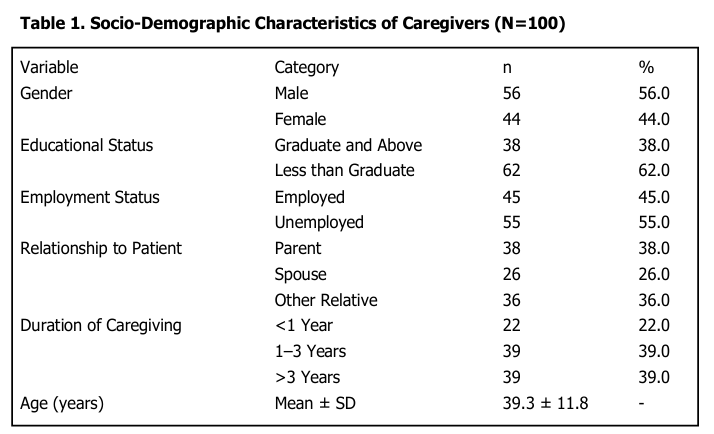
Table-1: Presents the socio-demographic
characteristics of the caregivers. The mean
age of the caregivers was 39.3 years (SD =
11.8). Male caregivers constituted 56% of the
sample, while females accounted for 44%.
Most caregivers had less than graduate-level
education (62%), and more than half were
unemployed (55%). Parents represented the
largest caregiving group (38%), followed by
spouses (26%) and other relatives (36%).
Regarding caregiving duration, 78% of
participants had been providing care for more
than one year, indicating the long-term nature
of caregiving responsibilities.
Table-2: Family Burden Interview
Schedule (FBIS) Scores Among
Caregivers (N = 100)
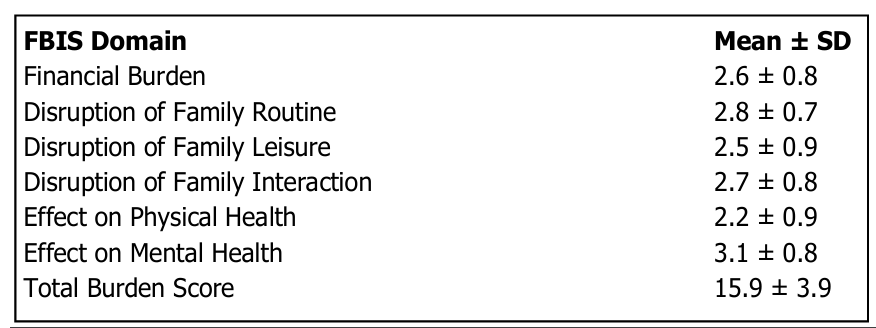
Table-2: Presents the burden experienced by
caregivers across various domains of the
Family Burden Interview Schedule (FBIS). The
highest burden was observed in the mental
health domain (M = 3.1, SD = 0.8), indicating
substantial psychological distress among
caregivers. This was followed by disruption
of family routine (M=2.8, SD=0.7) and
disruption of family interaction (M=2.7, SD
=0.8), suggesting that caregiving
responsibilities considerably affected daily
functioning and family relationships. Financial
burden (M=2.6, SD=0.8) and disruption of
leisure activities (M=2.5, SD=0.9) were also
notable. The impact on physical health
showed comparatively lower scores (M = 2.2,
SD = 0.9). The overall mean burden score
was 15.9 (SD = 3.9), indicating a considerable
level of caregiver burden within the study
sample.
Table-3: Multiple Linear Regression
Analysis Predicting Caregiver Burden (N
= 100).
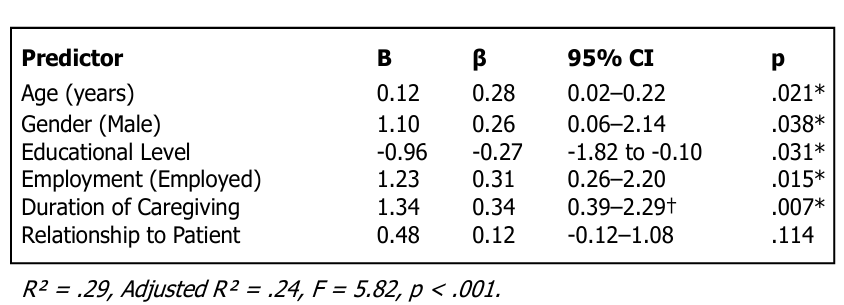
Table-3: Presents the results of the multiple
linear regression analysis examining socio
demographic predictors of caregiver burden.
The overall model was statistically significant
(F=5.82, p<.001) and explained 29% of the
variance in caregiver burden scores (R² = .29;
Adjusted R²=.24). Older age (â=.28, p=
.021), male gender (â=.26, p=.038),
employment (â=.31, p=.015), and longer
duration of caregiving (â=.34, p=.007) were
significantly associated with higher caregiver
burden. In contrast, higher educational
attainment was associated with lower
caregiver burden (â=-.27, p=.031).
Relationship to the patient did not significantly predict caregiver burden (p = .114).
DISCUSSION
The present study offers valuable insights into
the challenges faced by family caregivers of
individuals with severe psychiatric disorders,
based on a sample of 100 caregivers. The
findings indicate that caregiving for individuals
with chronic psychiatric conditions, such as
schizophrenia and bipolar disorder, is
associated with significant psychosocial
stress, particularly in the areas of mental
health impact, disruption of daily routines, and
family interactions.
The overall mean burden score was 15.9 ±
3.9, indicating a considerable level of
caregiver burden. The highest burden was
reported in the domain of mental health
impact, highlighting the emotional toll on
caregivers. These findings align with earlier
literature that emphasizes the psychological
challenges faced by caregivers, including
anxiety, depressive symptoms, and emotional
exhaustion (Kate et al., 2013; Grover et al.,
2012). Recent systematic reviews continue to
demonstrate substantial psychological burden,
emotional distress, and reduced quality of life
among caregivers of individuals with severe
mental illness (Tesfaye et al., 2025; Grover
et al., 2025).
Significant disruptions were also reported in
daily routines (M=2.8±0.7) and family
interactions (M=2.7±0.8), emphasizing how
caregiving responsibilities interfere with daily
functioning and family cohesion. These
disruptions are consistent with recent
evidence demonstrating that caregiving
responsibilities frequently interfere with
family functioning, social participation, and
daily routines among caregivers of individuals
with mental illness (Leta et al., 2025; Deng
et al., 2026).
Financial burden (M=2.6±0.8) emerged as
another significant area of concern, Financial
burden remains a major component of
caregiver burden, particularly in resource
constrained settings where caregivers
frequently bear treatment costs and indirect
productivity losses (Tesfaye et al., 2025; Leta
et al., 2025). Despite the presence of
government subsidies and hospital-based
support systems, out-of-pocket expenditures
remain high, especially in long-term
psychiatric care. These financial concerns
exacerbate stress and contribute to a
negative caregiving experience.
Disruption in leisure activities (M=2.5±0.9)
and the impact on physical health (M=2.2±
0.9) were relatively lower, though still
present. Recent evidence indicates that
caregiver burden is associated with poorer
physical health, psychological distress, and
reduced quality of life among family caregivers
(Esmaeeli et al., 2025; Gagiu et al., 2025).
Long-term caregiving responsibilities may
adversely affect caregivers’ physical and
psychological well-being, increasing stress,
fatigue, and health-related challenges (Deng
et al., 2026; Toleuov et al., 2025).
The study also explored associations between
caregiver burden and socio-demographic
factors. The association between older age
and higher burden is consistent with recent
evidence indicating that deteriorating
caregiver health and prolonged caregiving
responsibilities contribute to increased
caregiver stress and burden (Deng et al.,
2026).
Interestingly, male caregivers reported
significantly higher burden (B=1.10, p=
0.038). This finding challenges the traditional
assumption that female caregivers inherently
bear a higher burden. Instead, it resonates
with recent Indian studies indicating that
employed males may experience significant
role conflict between being primary financial
providers and taking on caregiving duties,
leading to heightened psychological distress
(Mathias et al., 2019).
Higher educational status was associated with l ower burden (B=“0.96, p=0.031).
Educational attainment may facilitate access
to health information, coping resources, and
support systems, which may contribute to
lower levels of caregiver burden (Esmaeeli et
al., 2025). The duration of caregiving showed
a significant positive association with burden
(B=1.34, p=0.007). The association between
longer caregiving duration and higher burden
i s
consistent with recent studies
demonstrating that prolonged caregiving
demands contribute to increased stress and
caregiver burden over time (Care Tasks and
Caregiver Burden Among Family Caregivers,
2025).
Recent evidence suggests that caregiver
burden among family caregivers of individuals
with mental illness remains a significant
global public health concern and is consistently
associated with adverse psychosocial
outcomes, psychological distress, and reduced
quality of life (Tesfaye et al., 2025).
Furthermore, caregiver burden has been
shown to negatively influence overall life
satisfaction and well-being among caregivers
of individuals with schizophrenia and other
severe mental illnesses (Esmaeeli et al.,
2025). Importantly, emerging evidence
i ndicates that structured psychosocial
interventions, caregiver support programmes,
psychoeducation, and community-based
support services can effectively reduce
caregiver burden, enhance coping capacities,
and improve the overall well-being of both
caregivers and care recipients (Sevillano
Garayoa et al., 2025). These findings highlight
the need for integrating caregiver-focused
interventions into routine mental healthcare
services to promote sustainable caregiving
and improve long-term treatment outcomes.
CONCLUSION
The present study highlights that the family
caregivers of individuals with severe
psychiatric disorders experience a moderate
to high level of burden, significantly impacting
their mental health, daily routines, and family
dynamics. Socio-demographic variables such
as age, gender, educational status,
employment, and duration of caregiving were
found to significantly influence the level of
burden experienced. Older age, male gender,
employment, and longer caregiving duration
were associated with higher burden, while
higher educational attainment appeared to be
a protective factor. These findings are
consistent with the socio-demographic branch
of Pearlin’s Stress Process Model, which
frames caregiver burden as an outcome of
accumulated stressors moderated by personal
and social resources. The results underscore
the complex and multifactorial nature of
caregiving burden in mental illness and
emphasise the need for comprehensive,
family-centred support mechanisms within the
mental healthcare system.RESULTS
IMPLICATION
Need for Caregiver-Centred Interventions:
The significant burden identified across
various domains highlights the urgent need
for targeted psychosocial interventions,
including counselling, psychoeducation, and
stress management for caregivers. Policy
Development for Family Support: The results
advocate for health policies that formally
recognise and support family caregivers
through services like respite care, financial
aid, and inclusion in treatment planning.
Diagnosis-Specific Support Programmes:
Given that schizophrenia and bipolar disorder
impose distinct types of burden, mental health
services should develop tailored caregiver
support interventions specific to each
diagnostic group. Attention to High-Risk
Caregiver Subgroups: Older, male, employed,
and long-duration caregivers represent
identifiable high-risk subgroups. Routine
burden screening in outpatient settings could
facilitate early referral to support services for these groups.
LIMITATIONS
Cross-Sectional Design: The study’s cross
sectional nature restricts the ability to
establish causal relationships between socio
demographic variables and caregiver burden
over time. Longitudinal research is needed to
understand how burden evolves across the
caregiving trajectory. Single-Centre Urban
Sample: As data were collected from one
urban tertiary hospital, the findings may not
be generalizable to rural populations,
community settings, or caregivers who do not
access formal psychiatric services. OPD-based
recruitment may over-represent caregivers
experiencing higher burden. Convenience
Sampling: The use of convenience sampling
introduces potential selection bias. Caregivers
who attended the OPD during the data
collection window may differ systematically
from those who did not.
REFERENCES
Andualem, F., Melkam, M., Tadesse, G., Nakie,
G., Tinsae, T., Fentahun, S., & Gedef,
G. M. (2024). Burden of care among
caregivers of people with mental
illness in Africa: A systematic review
and meta-analysis. BMC Psychiatry,
24, 778.
Awad, A. G., & Voruganti, L. N. (2008). The
burden of schizophrenia on caregivers.
PharmacoEconomics, 26(2), 149–162.
Chadda, R. K. (2014). Caring for the family
caregivers of persons with mental
illness. Indian Journal of Psychiatry,
56(3), 221–227.
Chakrabarti, S. (2013). Family caregivers of
people with schizophrenia: Need for
support. Indian Journal of Psychiatry,
55(Suppl. 2), S223–S229.
Esmaeeli, M., et al. (2025). Care burden
among family caregivers of patients
with schizophrenia: Relationships with
quality of life and life satisfaction.
Frontiers in Psychiatry, 16.
Grover, S., Dutt, A., & Avasthi, A. (2012). An
exploratory study on the experience
of caregiving: Burden, coping, and
quality of life in caregivers of patients
with schizophrenia. Asian Journal of
Psychiatry, 5(1), 23–28.
IBM Corp. (2019). IBM SPSS Statistics for
Windows (Version 26.0). IBM Corp.
Jain, A., Ray, T. K., Dhiman, B., Laskar, A. R.,
& Kataria, D. (2021). Family burden
among caregivers of mentally ill
patients residing in an urban
community of Delhi: A cross-sectional
study. Indian Journal of Community
Health, 37(2), 270–275.
Kate, N., Grover, S., Kulhara, P., & Nehra, R.
(2013). Relationship of quality of life
with coping and burden in primary
caregivers of patients with
schizophrenia. International Journal of
Social Psychiatry, 59(5), 445–453.
Kaur, N., Puria, A., Kumar, A., Chaudhury, S.,
Goyal, E., & Singh, V. P. (2021).
Caregiver burden among working
women and homemakers taking care
of psychiatric patients. Industrial
Psychiatry Journal, 30(Suppl. 1),
S166–S171.
Kohn, R., Saxena, S., Levav, I., & Saraceno,
B. (2004). The treatment gap in
mental health care. Bulletin of the
World Health Organization, 82(11),
858–866.
Leta, F. O., et al. (2025). Family caregiver
burden and associated factors among
caregivers of people with mental
illness. BMC Psychiatry, 25.
Magliano, L., Fiorillo, A., De Rosa, C.,
Malangone, C., & Maj, M. (2005).
Family burden and social network in
schizophrenia versus physical
diseases. Social Science & Medicine,
61(2), 313–322. Mathias, K., Kermode, M., San Sebastian, M.,
Davar, B., & Goicolea, I. (2019). An
asymmetric burden: Experiences of
men and women as caregivers of
people with psychosocial disabilities in
rural North India. Transcultural
Psychiatry, 56(1), 76–102.
Obungu, N., et al. (2026). Mental wellbeing
of family caregivers of people living
with mental illness: A systematic
review. BMC Psychiatry, 26.
Pai, S., & Kapur, R. L. (1981). The burden on
the family of a psychiatric patient:
Development of an interview
schedule. British Journal of Psychiatry,
138(4), 332–335.
Pearlin, L. I., Mullan, J. T., Semple, S. J., &
Skaff, M. M. (1990). Caregiving and
the stress process: An overview of
concepts and their measures. The
Gerontologist, 30(5), 583–594.
Perlick, D. A., Rosenheck, R. A., Clarkin, J. F.,
Maciejewski, P. K., Sirey, J. A.,
Struening, E. L., & Link, B. G. (2007).
Adverse effects of perceived stigma
on social adaptation of persons
diagnosed with bipolar disorder.
Psychiatric Services, 58(6), 794–801.
Perlick, D. A., Rosenheck, R. A., Clarkin, J. F.,
Raue, P., Sirey, J. A., & Struening, E.
L. (2006). Impact of family burden
and patient symptom status on clinical
outcome in bipolar disorder. Journal
of Nervous and Mental Disease,
194(1), 25–30.
Rammohan, A., Rao, K., & Subbakrishna, D.
K. (2002). Burden and coping in
caregivers of persons with
schizophrenia. Indian Journal of
Psychiatry, 44(3), 220–227.
Reinares, M., Vieta, E., Colom, F., Martínez
Arán, A., Torrent, C., Comes, M., &
Benabarre, A. (2006). What really
matters to bipolar patients’
caregivers: Source of family burden.
Journal of Affective Disorders, 94(1
3), 157–163.
Rojo, E., et al. (2026). Associations between
the recovery process and caregiver
burden among family caregivers of
people with severe mental illness.
Humanities and Social Sciences
Communications, 13.
Saunders, J. C. (2003). Families living with
severe mental illness: A literature
review. Issues in Mental Health
Nursing, 24(2), 175–198.
Shah, A. J., Wadoo, O., & Latoo, J. (2010).
Psychological distress in carers of
people with mental disorders. British
Journal of Medical Practitioners, 3(3),
a327.
Tesfaye, E., & Demelash, K. (2025). Burden
of care among caregivers of patients
with mental illness: A systematic
review and meta-analysis. BMC Public
Health, 25.
Thara, R., & Srinivasan, T. N. (2000). How
stigmatizing is schizophrenia in India?
International Journal of Social
Psychiatry, 46(2), 135–141.
World Health Organization. (1992). The ICD
10 classification of mental and
behavioural disorders: Clinical
descriptions
and diagnostic
guidelines. World Health Organization.
World Health Organization. (2021).
Comprehensive mental health action
plan 2013–2030. World Health
Organization.
Yesufu-Udechuku, A., Harrison, B., Mayo
Wilson, E., Young, N., Woodhams, P.,
Shiers, D., & Kendall, T. (2015).
Interventions to improve the
experience of caring for people with
severe mental illness: Systematic
review and meta-analysis. British
Journal of Psychiatry, 206(4), 268
274.
Zarit, S. H., Reever, K. E., & Bach-Peterson, J. (1980). Relatives of the impaired
elderly: Correlates of feelings of
burden. The Gerontologist, 20(6),
649–655.
Zarit, S. H., Todd, P. A., & Zarit, J. M. (1986).
Subjective burden of husbands and
wives as caregivers: A longitudinal
study. The Gerontologist, 26(3), 260
266.
Conflict of interest: None
Role of funding source: None
