
Indian Journal of Health Social Work
(UGC CARE List Journal)
A STUDY ON IMPACT OF STRESS EXPERIENCED BY ASPIRANTS
WHO UNDERWENT RESIDENTIAL COMPETITIVE EXAM COACHING
Hridya1, Atiq Ahmed2, Upendra Singh3
1M Phil Scholar Dept of PSW, MIMH, Pune, 2Assistant Professor, Central University of
Rajasthan, Ajmer 3Assistant Professor, Dept of PSW, MIMH, Pune
Correspondence: Upendra Singh, e-mail: upendrasingh.aims@gmail.com
ABSTRACT
Background: Competitive exams like NEET and JEE are seen in India as gateways to prestigious
careers, leading to the expansion of residential coaching centres. While these centres provide
academic training, the intense pressure, hostel restrictions, and parental expectations often
generate high stress with long-term mental health consequences. Aim: This study examined the
impact of stress experienced by aspirants during residential coaching in Kerala and its influence
on their academic, emotional, and personal development. Methodology: A descriptive reserach
design was used, and data were collected from 83 participants through a socio-demographic
schedule, a structured questionnaire, and the Impact of Event Scale-Revised (IES-R). Results:
Findings indicated that most participants faced significant stress, reflected in loss of self
confidence, low self-esteem, academic decline, and emotional difficulties. About 18.1% sought
professional mental health support, and 20.5% reported suicidal thoughts or self-harm tendencies.
Parental support emerged as a protective factor, while hostel restrictions, particularly reduced
communication with family, were strongly associated with fear of failure and heightened anxiety
about the future. Conclusion: The study concludes that residential coaching exerts lasting negative
effects beyond academics, impacting emotional and personal well-being. Reforms in coaching
and hostel practices, improved support systems, and integration of counselling services are
essential to safeguard aspirants’ mental health. The findings underscore the role of social work
interventions in promoting resilience and holistic growth within competitive learning environments.
Keywords: Stress, Mental health, Parental support.
Submitted: 27.01.2026 Revised: 30.03.2026 Accepted: 30.06.2026 Published: 30.07.2026
How to cite this article: Hridya, Ahmed, A., Singh, U. (2026). A Study on Impact of Stress
Experienced by Aspirants Who Underwent Residential Competitive Exam Coching. Indian Journal
of Health Social Work, 8(1), 72-78.
INTRODUCTION
India’s higher education system is among the
l argest in the world, yet entry into
professional programs particularly medicine
and engineering remains fiercely competitive.
The National Eligibility cum Entrance Test
(NEET) and the Joint Entrance Examination (JEE) are among the most demanding
national-level entrance examinations,
attracting millions of aspirants each year for
a limited number of seats. In 2023, more than
1.8 million students registered for NEET to
compete for fewer than 92,000 MBBS seats,
while nearly one million appeared for JEE for
restricted engineering admissions. To bridge
the widening gap between aspirations and
opportunities, residential coaching centers
have proliferated across the country,
especially in states such as Rajasthan and
Kerala. These centers provide intensive
academic training, regimented routines, and
long study hours; however, their preparation
model has been increasingly associated with
adverse psychological consequences. Reports
from Kota, the nation’s largest coaching hub,
documented 26 student suicides in 2023 the
highest ever in a single year, while National
Crime Records Bureau (NCRB) statistics
revealed that more than 13,000 students
across India died by suicide in 2022, with over
1,100 cases linked to exam-related stress.
These alarming figures underscore the
urgency of examining aspirants’ lived
experiences within such environments,
particularly in Kerala, where coaching culture
is deeply embedded but underexplored in
research.
Existing scholarship demonstrates that
aspirants are highly vulnerable to academic
stress. The pressure arises from vast syllabi,
extended study schedules, frequent
assessments, and a pervasive culture of peer
comparison, all of which demand sustained
high performance (Jain et al., 2018; Gupta,
2020). Stress is further compounded by socio
economic disparities, as students from lower
income families shoulder financial burdens
alongside academic challenges (Sinha &
Mathur, 2019). The COVID-19 pandemic
intensified these struggles by disrupting exam
schedules and forcing a sudden shift to online
learning, which created additional uncertainty
and heightened anxiety among students (Deb
et al., 2024). Documented psychological
outcomes include anxiety, depression,
diminished self-esteem, and psychosomatic
complaints such as headaches, fatigue, and
digestive issues (Pienyu et al., 2017).
Prolonged exposure has also been linked to
trauma-like responses, including intrusive
thoughts, avoidance, and hyperarousal
resembling post-traumatic stress disorder
(Elhai et al., 2018; Sesar et al., 2019).
Residential coaching centers are often
described as a “parallel education system” in
India (Orberg, 2017). While these institutions
promise improved exam preparedness,
studies reveal that their highly structured,
restrictive environments frequently neglect
holistic development. Research in Kota has
documented elevated levels of depression,
anxiety, and suicidal ideation among
aspirants, exacerbated by restrictive hostel
rules, reduced family contact, and the absence
of psychosocial support (Gautam et al., 2019;
Gupta, 2020). National data echo these
concerns, with NCRB (2022) attributing
student suicides to a convergence of academic
burden, parental expectations, and
institutional pressures (Rao, 2021).
At the same time, several protective factors
have been identified. Among them, parental
support stands out as particularly significant.
Encouragement and open communication
foster resilience, while authoritarian or critical
parenting intensifies distress (Shahnawaz,
2013). Peer networks and institutional
counseling programs have also been found
effective in alleviating stress and
strengthening coping mechanisms (Bharti et
al., 2026). Recognizing these issues, the
Ministry of Education (2024) issued guidelines
for coaching centers mandating counseling
services, regulated study hours, co-curricular
activities, and improved hostel facilities.
However, implementation has been
inconsistent, particularly in smaller towns andv private institutions, raising doubts about their
effectiveness (Mehrotra & Vijayakumar, 2025).
The study is informed by Lazarus and
Folkman’s Transactional Model of Stress and
Coping, which conceptualizes stress as a
dynamic interaction between individuals and
their environment. The model provides a
useful framework for understanding how
aspirants perceive and respond to academic
demands, hostel restrictions, and social
support during residential coaching.
Despite an expanding body of research on
aspirants in Kota and other hubs, limited
scholarship exists in Kerala, where high
literacy rates and strong parental aspirations
have fueled widespread dependence on
coaching for both NEET and KEAM. Most
existing studies focus on immediate stress
during the coaching period, with limited
attention to the long-term psychological
consequences after students leave these
centers. Addressing this gap, the present
study investigates both the immediate and
enduring impacts of residential coaching on
aspirants in Kerala, with particular emphasis
on the roles of hostel restrictions, parental
support, and coping strategies in shaping
mental health outcomes.
METHODOLOGY
Research Design
The present study employed a descriptive
research design to examine the stress
experienced by aspirants during their
residential coaching period and its long-term
impact on their personal and academic lives.
The study specifically focused on the
underexplored context of Kerala, where
coaching culture is widespread but its
psychological consequences have not been
sufficiently documented.
Participants and Sampling
The study population consisted of aspirants
from Kerala who had attended residential
coaching programs for NEET, JEE, or other
engineering entrance examinations after
completing higher secondary school. The
inclusion criteria were: (a) age 18 years or
above, and (b) previous experience of
residential coaching. Students currently
undergoing coaching were excluded.
A cluster sampling technique was adopted to
ensure representation of participants from
different coaching centers. A total of 83
respondents participated in the study,
providing adequate variation in age, gender,
educational background, and duration of
coaching.
Tools used in the study:
Socio-Demographic Data Sheet: Designed
by the researcher to collect information on
participants’ age, gender, educational
qualification, duration of coaching, and family
background.
Researcher – Made Questionnaire:
Developed to capture participants’ subjective
experiences during and after coaching,
including perceptions of parental support,
hostel environment, coping strategies, and
long-term impacts.
Impact of Event Scale-Revised (IES-R):
A standardized 22-item self-report measure
used to assess psychological distress across
three dimensions: Intrusion, Avoidance, and
Hyperarousal. Each item was rated on a 5
point Likert scale, yielding subscale and total
scores. The IES-R has demonstrated strong
reliability and validity in previous studies
(Weiss & Marmar, 1997).
Data were analyzed using both descriptive and
inferential statistics on SPSS v25. Descriptive
statistics (frequencies, percentages)
summarized socio-demographic variables and
IES-R scores.
RESULTS
The study analyzed responses from 83
participants who had attended residential coaching in Kerala. Findings are presented
under socio-demographic details,
psychological outcomes (IES-R scores),
statistical associations, and thematic impacts.
Table-1: Socio-demographic
Characteristics of Respondents (N = 83).
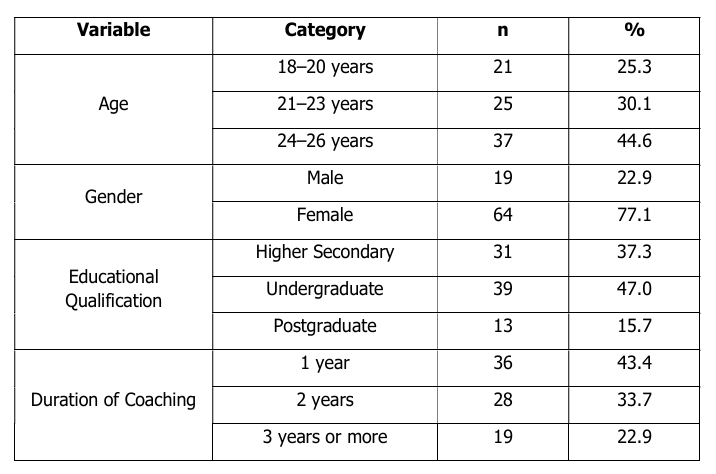
Table-1: Shows that sample consisted of 83
participants, most of whom were between 24
26 years of age (44.6%), followed by those
aged 21–23 years (30.1%). A majority of the
participants were female (77.1%), with only
22.9% being male. Regarding education,
nearly half had completed undergraduate
studies (47.0%), while 37.3% had only higher
secondary education and 15.7% were
postgraduates. In terms of coaching duration,
43.4% reported one year of coaching, 33.7%
reported two years, and 22.9% had three or
more years of residential coaching. These
findings suggest that the sample was largely
composed of young adult women who invested
at least one year in residential coaching
programs.
Table-no 2: Perceived Parental Support
and Hostel Environment (N=83).
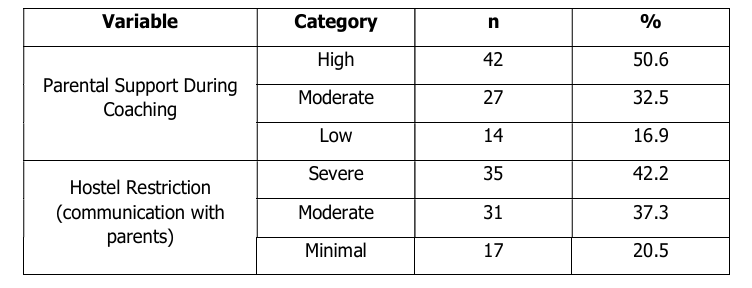
Table no.-2: Shows that most participants
reported receiving high levels of parental
support (50.6%), while 32.5% indicated
moderate support, and 16.9% perceived low
support during their coaching period. In terms
of hostel restrictions, more than four out of
ten participants (42.2%) reported severe
restrictions on communication with parents,
whereas 37.3% described moderate
restrictions and only 20.5% experienced
minimal restrictions. This highlights that
despite some parental support, many
aspirants experienced social isolation in their
hostel environment, limiting their access to
emotional support.
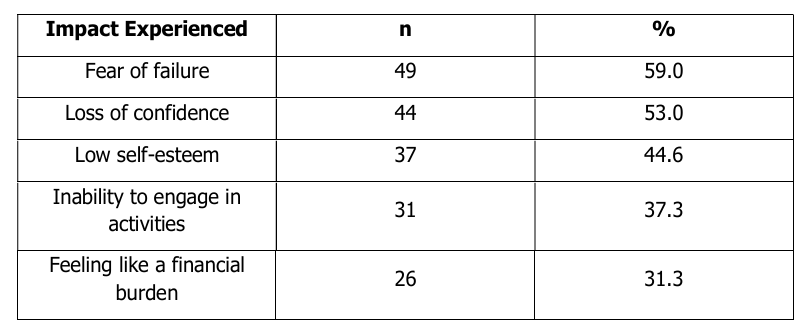
Table no.-3: Psychological Impacts
Reported by Participants on self
reported questionnaire.
Pearson’s correlation analysis (Table 3)
showed that resilience was positively
associated with social support (r = .61, p <
.01), community participation (r = .48, p <
.01), and adaptive coping (r = .52, p < .01).
This indicates that higher support,
participation, and constructive coping were
linked with greater resilience. Conversely,
resilience was negatively correlated with
maladaptive coping (r = -.38, p < .01),
suggesting that avoidant or harmful coping
lowered resilience. Social support and
community participation were also positively
related, while maladaptive coping showed
consistent negative associations with other
variables. Overall, these findings highlight that
social and adaptive resources enhance
resilience, whereas maladaptive coping
undermines it.
Table-4: Multiple Regression Analysis
Predicting Resilience (N=400).
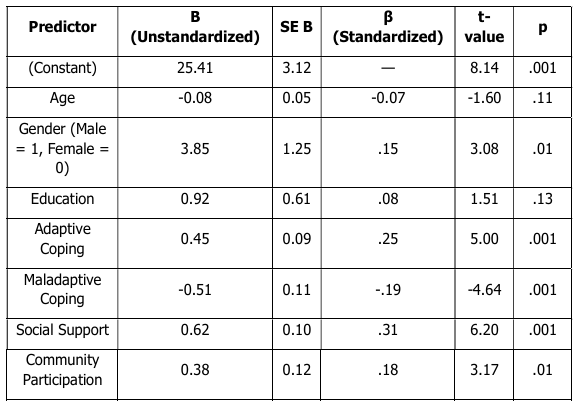
Table no-3: Found that participants reported
experiencing several psychological
consequences of residential coaching. The
most common impact was fear of failure
(59.0%), followed closely by loss of confidence
(53.0%) and low self-esteem (44.6%). Over
one-third of respondents (37.3%) reported
being unable to engage in activities they
previously enjoyed, while nearly one-third
(31.3%) felt like a financial burden on their
families. These findings indicate that the
stress associated with residential coaching
extended beyond academics, affecting
participants’ self-concept and emotional well
being.
Table-4: IES-R Scores Across Selected
Characteristics among the participants.
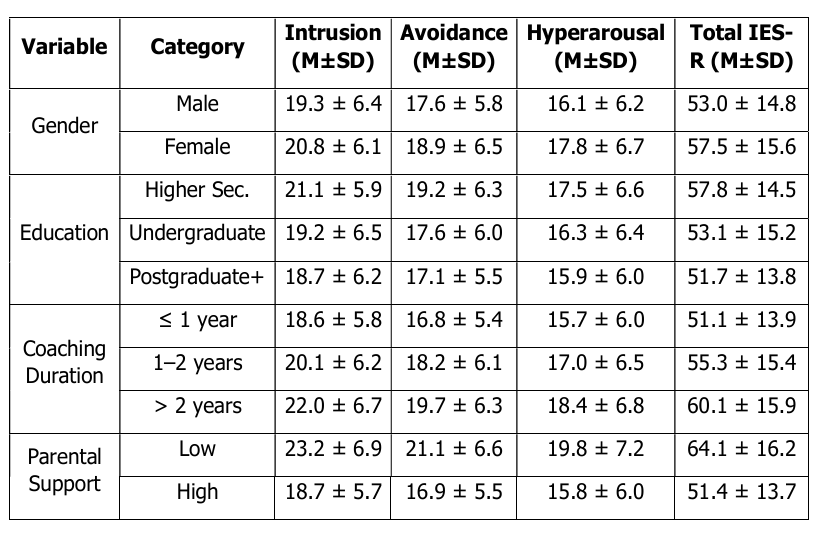
Table-4: Shows that overall, the Impact of
Event Scale-Revised (IES-R) results revealed
significant differences across gender, parental
support, and hostel restrictions. Female
participants reported higher mean scores
across all dimensions intrusion, avoidance,
and hyperarousal compared to male
participants, suggesting greater psychological
distress among women. Similarly, participants
with low parental support had significantly
higher IES-R scores than those with high
support, indicating that parental involvement
acted as a protective factor against stress.
Furthermore, participants who reported
severe hostel restrictions scored markedly
higher on all IES-R subscales compared to
those with minimal restrictions. These results
demonstrate that limited communication with
parents and reduced autonomy contributed to
heightened levels of post-traumatic stress
symptoms.
DISCUSSION
The present study employed an exploratory
descriptive design to examine the
psychological impact of residential coaching
among aspirants in Kerala, utilizing a
researcher-made socio-demographic
questionnaire, a structured survey on
subjective experiences, and the Impact of
Event Scale-Revised (IES-R). This mixed
approach allowed for both quantitative
assessment of stress symptoms and
qualitative insights into parental support and
hostel restrictions. The use of the IES-R, a
standardized measure with demonstrated
reliability (Weiss & Marmar, 1997), provided
a valid framework for understanding the
persistence of stress-related symptoms in this
population.
The socio-demographic profile revealed that
the sample was predominantly female
(77.1%), aged between 24-26 years, and
largely undergraduate or higher secondary
qualified. This suggests that women are
increasingly engaged in competitive exam
preparation, reflecting recent national trends
where female enrollment in NEET has
surpassed males (George, 2023). The finding
that nearly half of participants invested at
l east one year in residential coaching
highlights the significant time and financial
commitment families make, echoing Jain at
ai., (2018) observations on the intensive
nature of exam preparation in India.
The majority of participants reported
moderate to high parental support, but more
t han 40% experienced severe hostel
restrictions, especially limited communication
with parents. This duality suggests a mismatch
between external family support and internal
institutional structures. Earlier research
(Shahnawaz, 2013) identified parental
emotional support as a key buffer against
stress; however, when institutional rules
hinder parent-child communication, this
protective effect is weakened. Similar findings
were reported by Gautam et al. (2019), who
observed that strict hostel policies in Kota
contributed significantly to anxiety and
depression among students.
Fear of failure (59%), loss of confidence
(53%), and low self-esteem (45%) were
among the most frequently reported
psychological impacts. These findings align
with Gupta (2020), who emphasized that
academic overload and peer comparisons in coaching environments contribute to
diminished self-worth. The perception of
being a financial burden on the family (31%)
further underscores the economic dimension
of stress, a factor also highlighted in
Chelackoden and Vidya’s (2024) systematic
review of adolescent stressors in competitive
settings.
Analysis of IES-R scores demonstrated that
female aspirants, those with low parental
support, and students under severe hostel
restrictions consistently reported higher mean
scores across intrusion, avoidance, and
hyperarousal dimensions. This indicates that
gender and social support systems critically
shape stress outcomes. Afek et al. (2021)
similarly noted that adolescents with weaker
support systems display greater vulnerability
to intrusive thoughts and impaired inhibitory
control. The persistence of high IES-R scores
years after coaching highlights the trauma
like effects of prolonged academic stress,
echoing the findings of Gao, (2023).
CONCLUSION
The study found that residential coaching
significantly affects aspirants’ psychological
well-being, with many reporting moderate to
severe stress, loss of confidence, and
intrusive exam-related thoughts. Restrictive
hostel environments emerged as a major
contributor to distress, while parental support
acted as a protective factor. Importantly, these
impacts extended beyond the coaching period,
i nfluencing long-term confidence and
academic engagement. The findings highlight
the need for reforms in coaching systems to
balance academic preparation with mental
health support and parental involvement.
LIMITATIONS AND FUTURE RESEARCH
The study relied on self-reported data and was
limited to Kerala, affecting generalizability. Its
cross-sectional design restricted causal
i nsights, and the absence of clinical
assessments narrowed the focus to stress
outcomes only. Future research should adopt
longitudinal and comparative designs, use
mixed-methods approaches, and evaluate
intervention strategies such as counselling
services, hostel reforms, and parental
orientation programs.
REFERENCES
Afek, A., Givon, N., & Hertz, R. (2021).
Psychological resilience, mental
health, and inhibitory control among
youth experiencing stress. Journal of
Adolescent Research, 36(4), 487–505.
Bharti, B., Malhotra, N., Virk, A., Kaur, V.,
Malhi, P., & Loomba, P. (2026). Peer
led mentoring intervention for test
anxiety reduction among medical
students:
Development,
i mplementation, and prospective
evaluation. BMC Medical Education,
26(1), 369.
Chelackoden, A., & Vidya, R. (2024).
Stressors, coping strategies, and
support systems among adolescents
in competitive academic settings: A
systematic review. Asian Journal of
Psychology and Education, 13(2), 65
79.
Deb, S., Dorji, N., Kar, S., Sunny, A. M., Deb,
S., Ghosh, S., & Chakraborty, S.
(2023). COVID-19 and stress of Indian
youth: An association with
background, online mode of teaching,
resilience and hope. Journal of
Affective Disorders Reports, 12,
100502.
Elhai, J. D., Dvorak, R. D., Levine, J. C., & Hall,
B. J. (2017). Problematic smartphone
use: A conceptual overview and
systematic review of relations with
anxiety
and
depression
psychopathology. Journal of Affective
Disorders, 207, 251–259.
Gao, X. (2023). Academic stress and academic burnout in adolescents: A
moderated mediating model. Frontiers
in Psychology, 14, 1133706.
Gautam, S., Singh, B. G., & Rao, S. R. (2019).
Depression in Kota coaching students
in relation to motivation-type and
perceived ability. Think India Journal,
22, 866–873.
George, A. S. (2023). The race to success: A
study of the NEET and JEE exams’
impact on students’ lives. Academic
Press.
Gupta, R. K. (2020). Academic stress and
mental health among adolescent
students. International Journal of
Indian Psychology, 8(2), 384–390.
Joshi, M., Singh, N. K., Chaturvedi, A., &
Bapat, V. (2025). Effects of academic
pressure on students’ health and well
being: A comprehensive analysis.
International Journal of Indian
Psychology, 13(4).
McCloud, T., & Bann, D. (2019). Financial
stress and mental health among
higher education students in the UK
up to 2018: Rapid review of evidence.
Journal of Epidemiology and
Community Health, 73(10), 977–984.
Mehrotra, S., & Vijayakumar, L. (2025).
Strengthening student mental health
support systems in India: Reflections
on the Supreme Court’s landmark
guidelines. The Lancet Regional
Health – Southeast Asia, 43.
Ministry of Education. (2024). Guidelines for
regulation of coaching centres, 2024.
Government of India.
National Crime Records Bureau. (2022).
Accidental deaths and suicides in India
2022. Ministry of Home Affairs,
Government of India.
Ørberg, J. W. (2018). Uncomfortable
encounters between elite and shadow
education in India: Indian Institutes of
Technology and the Joint Entrance
Examination coaching industry. Higher
Education, 76(1), 129–144.
Pienyu, K., Margaret, B., & D’Souza, A.
(2024). Academic stress, perceived
parental pressure, and anxiety related
to competitive entrance examinations
and general well-being among
adolescents: A cross-sectional survey
from Karnataka, India. Journal of
Education and Health Promotion, 13,
474.
Rao, S. (2021). Student suicides in India:
Academic pressure and systemic
failure. Economic and Political Weekly,
56(34), 23–26.
Shahnawaz, G. (2013). Social support, self
efficacy, and resilience as predictors
of achievement motivation among
competitive exam aspirants. Journal of
the Indian Academy of Applied
Psychology, 39(3), 50–57.
Weiss, D. S., & Marmar, C. R. (1997). The
Impact of Event Scale–Revised. In J.
P. Wilson and T. M. Keane (Eds.),
Assessing psychological trauma and
PTSD (pp. 399–411). Guilford Press.
Conflict of interest: None
Role of funding source: None
