

Indian Journal of Health Social Work
(UGC CARE List Journal)
INSTRUCTION FOR AUTHORS
AIMS AND SCOPE
Aims
work practice, education, and research. The journal aims to:
◾️ Publish high-quality, original research that contributes to the understanding of health-related social issues
◾️ Promote evidence-based social work practice in healthcare settings
◾️ Encourage interdisciplinary collaboration among social work, public health, medicine, and allied disciplines
◾️ Provide a platform for researchers, practitioners, and policymakers to disseminate innovative ideas and findings
◾️ Contribute to the development of equitable, inclusive, and sustainable health systems
◾️The journal seeks to bridge the gap between theory, research, and practice in health social work at the national and international levels.
The journal welcomes manuscripts addressing a broad range
of topics within health social work, and allied fields, including
but not limited to:
Health Social Work Practice
◾️ Medical and Psychiatric Social Work
◾️Hospital-based social work interventions
◾️ Palliative and End-of-Life Care
◾️ Rehabilitation and Disability Studies
Public Health and Community Health
◾️ Community Health and Primary Healthcare
◾️ Health Promotion and Disease Prevention
◾️ Epidemiology and Social Determinants of Health
◾️ Maternal and Child Health
Mental Health and Psychosocial Well-being
◾️ Mental Health Interventions and Counselling
◾️ Psychosocial Support in Crisis and Disaster Situations
◾️Substance Use and Addiction Studies
◾️ Trauma, Stress, and Coping Mechanisms
Health Policy and Systems
◾️ Health Policy Analysis and Implementation
◾️ Health Governance and Administration
◾️ Universal Health Coverage and Equity
◾️ Health Insurance and Financing
Social Dimensions of Health
◾️ Gender and Health
◾️ Ageing and Geriatric Care
◾️ Child Health and Protection
◾️ Marginalised and Vulnerable Populations
Interdisciplinary and Emerging Areas
◾️Digital Health and Tele-social Work
◾️Environmental Health and Sustainability
◾️Occupational Health and Workplace Well-being
◾️Ethics and Human Rights in Healthcare
The journal particularly encourages research that integrates
social work perspectives with health systems, policy
frameworks, and community-based interventions.
Publication Frequency The “Indian Journal of Health Social Work” is a biannual journal published in January and July of each year.
In keeping with international standards of bibliographic accountability, from the forthcoming issue onward (Volume 7 | Issue 2), all articles published in the Indian Journal of Health Social Work will carry complete and consistent publication records. Dates such as “Submitted”, “Revised”, “Accepted” and “Published” will be mentioned on the first page of each manuscript. This ensures verifiable, transparent publication records that authors may cite in their academic credentials, and that evaluating bodies, including university appointment committees, may rely on with confidence.
Indicative word limits for each category are as follows. The word limit ordinarily includes the abstract, tables/figures, and references, unless otherwise specified.
• Original Research Papers: This section publishes original quantitative, qualitative, mixed-method, or practice-based research papers. Original Research Papers should ordinarily be less than 5000 words.
• Commentary & Invited Articles: This section publishes short analytical, reflective, or perspective-based articles on specific issues relevant to the journal’s scope. Commentary & Invited Articles should ordinarily be 2000–3000 words.
• Forum: This section provides space for concise discussion, exchange of ideas, or responses on issues of academic or professional relevance. Forum contributions should ordinarily be 1200–2000 words.
• Case Reports: This section publishes reports of new, interesting, or rare cases of professional significance in the field of health care social work practice. Case Reports should ordinarily be 1500–2500 words.
• Brief Communication: This section publishes concisereports from preliminary studies, pilot work, smaller datasets, field-based observations, or other emerging issues of significance. Brief Communications should ordinarily be 1200 2000 words.
• Letters to the Editor: A brief letter (maximum 500 words, including references, and without tables or figures) will be considered under this section. All submissions must demonstrate originality, methodological rigour, and relevance to the journal’s scope.
MANUSCRIPT FORMAT
A. Title Page (to be submitted separately)
◾️ The title of the article should be bold, centred, and typed
in normal size with 12 points and a Times New Roman
font.
◾️ The title page should be uploaded separately and should
contain the full article title, author name(s), academic/
professional designation, institutional affiliation, ORCID
ID where available, postal address, pin code, email, and
mobile number of the corresponding author.
B. Main Manuscript File
The main manuscript file should contain the title, abstract,
keywords, main text, tables/figures, acknowledgements,
funding information, declaration of interest, ethics statement
where applicable, and references, as relevant to the article
category, but should not contain author names or any other
identifying information.
C. Abstract and Keywords
◾️ Except for Letters to the Editor, all manuscripts should
ordinarily be accompanied by an abstract written in clear
English.
◾️ The abstract should ordinarily not exceed 300 words and
should be followed by 3 to 6 keywords.
◾️ Abstract should ordinarily include the background, aims/
objectives, method, results, conclusion, and keywords,
wherever applicable to the article type.
D. Contents of the Write-up
◾️ The manuscript should be written in English and should
conform to the word limit prescribed for the relevant
article category.
◾️ As a general rule, submissions should follow the indicative
limits stated under Article Types.
◾️ Manuscript or informative material should be typed in 12
point font size and Times New Roman with line spacing
of 1.5 and single column on standard A4 size paper.
◾️ All headings must be bold-faced, aligned left with 12
points in Times New Roman, and sub-headings in 10
points.
◾️Article titles should be informative, reflecting the true
sense of the manuscript, and within two lines.
◾️Tables should be numbered and accompanied by short
titles at the top.
◾️The authors should make sure that tables and figures are
referred to in the main text.
◾️References should include a list of all articles and books
at the end of the paper. Arrange alphabetically by the
author’s names and date of publication in parentheses.
The author should follow the APA 7th edition style for
the reference list.
◾️Declaration of interest must be mentioned by the author
at the submission. Funding support, if any, and an ethics
statement, where applicable, should be provided before
the references.
Note: Click here to download the manuscript template
All editorial decisions are made solely by the Editor-in-Chief and Editorial Board on the basis of scholarly merit and peer review. The All India Association of Medical Social Work Professionals (AIAMSWP), as the publisher, has no role in manuscript selection or rejection. No acceptance or rejection is i nfluenced by commercial, political, or institutional considerations.
Manuscripts submitted by any member of the Editorial Board are handled by a separate editor who was not involved in the original submission and has no conflict of interest with the author. The submitting editor is excluded from all stages of the review and decision process. Double-blind peer review applies in all such cases.
IJHSW welcomes proposals from eminent scholars and practitioners to serve as Guest Editors or continue with the existing editorial team for Special Issues focused on emerging themes in health social work, medical and psychiatric social work, palliative care, community health interventions, and interdisciplinary healthcare practice. Proposals should include a brief thematic rationale, a proposed timeline, and a list of potential contributors. Guest editors will be formally acknowledged in the published special issue and on the journal’s website. Interested scholars may write to the Editorial Office at aiamswpeditor@gmail.com.
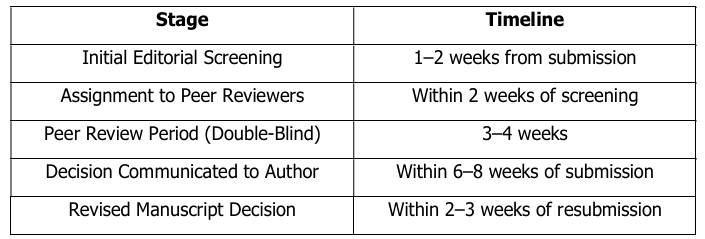
All submissions received by the Indian Journal of Health Social Work (IJHSW) are subject to editorial screening before publication. Manuscripts found suitable for peer review ordinarily undergo a rigorous double-blind peer-review process to ensure quality, validity, and academic integrity. The journal adheres to established ethical guidelines in scholarly publishing. Manuscripts considered appropriate for external review are ordinarily sent to at least two independent reviewers under a double-blind peer-review process. Final decisions are taken by the Editor-in-Chief and/or Editorial Board on the basis of reviewer comments, scholarly merit, and the journal’s scope.
REVIEW TIMELINE
RESEARCH ETHICS POLICY
For manuscripts involving human participants, personal data,
case material, interviews, surveys, or institutional records,
authors should state whether ethics approval, permission,
exemption, waiver, or a statement that such approval was not
required applies under relevant institutional or disciplinary
norms. Where applicable, authors should confirm informed
consent and appropriate confidentiality safeguards. Where such
approval or permission is not reasonably available, the Editor
may exercise discretion in light of the nature of the work and
the ethical safeguards described by the author.
REVIEWER POOL ACKNOWLEDGED
IJHSW sincerely recognises the invaluable contribution of its
peer reviewer community. The journal periodically
acknowledges the contributions of its peer reviewers in the
journal and/or on the website. Scholars with expertise in medical
social work, psychiatric social work, public health, community
medicine, palliative care, disability studies, and related fields
are welcome to register as reviewers. To join the IJHSW
Reviewer Panel, please write to the Editorial Office with your
areas of expertise and institutional affiliation.
OPEN ACCESS POLICY
This is an E-journal that provides immediate free access to all
published articles and is publicly available, supporting
worldwide knowledge exchange on the association’s website.
CREATIVE COMMONS
Articles published from the forthcoming issue onward will
ordinarily be made available under the Creative Commons
Attribution 4.0 International licence (CC BY 4.0), unless
otherwise stated.
PLAGIARISM POLICY
The journal is strictly against any unethical act of copying or
plagiarism in any form. Plagiarism is said to have occurred
when large portions of a manuscript have been copied from
existing, previously published resources. All manuscripts
submitted for publication to the Indian Journal of Health Social
Work may be screened for plagiarism by the Editorial Office
using appropriate tools or reports. Manuscripts found to contain
substantial overlap, unattributed copying, or other forms of
plagiarism at any stage of review or publication may be
rejected, returned for clarification, or withdrawn, as appropriate.
Authors may also be asked to submit a plagiarism report where
required by the journal.
AI DISCLOSURE POLICY
IJHSW requires authors to disclose any use of Artificial
Intelligence (AI) or AI-assisted tools, including large language
models, AI writing assistants, AI-based data analysis, or image
generation tools, in the preparation, writing, or analysis of
their submitted manuscript. Such disclosure must be included
under a clearly labelled subsection within the Methods or
Acknowledgements section, specifying the tool(s) used and
the nature of their application.
CORRECTION POLICY
IJHSW is committed to maintaining the integrity and accuracy
of the published scholarly record. Where significant factual
errors are identified in a published article by the authors, editors,
or readers, authors are provided an opportunity to correct their
manuscript in accordance with the journal’s correction policy.
In cases involving serious ethical violations such as plagiarism,
data fabrication, or undisclosed duplicate publication, the journal
will issue an Expression of Concern or proceed with a formal
Retraction in accordance with the guidelines of the Committee
on Publication Ethics (COPE). Retracted articles will remain
accessible in the archive and will be clearly marked as retracted
with the reason stated. Authors, reviewers, and readers are
encouraged to report concerns to the Editorial Office.
APPEALS AND COMPLAINTS
Authors who wish to appeal a rejection must email the Editor
in-Chief at aiamswpeditor@gmail.com within 7 days, quoting
their Manuscript ID and stating the grounds for appeal. Appeals
are considered only where a procedural error or material
misunderstanding is alleged; disagreement with the reviewer’s
judgement alone is not sufficient. Appeals will be acknowledged
within 7 working days and ordinarily decided within 30 working
days. Where appropriate, the appeal may be referred to an
editor not involved in the original decision. Complaints about
editorial conduct may be raised with the Editor-in-Chief.
JOURNAL SPONSORSHIP
The Indian Journal of Health Social Work is an official publication
of the All India Association of Medical Social Work Professionals
(AIAMSWP). So, the journal is not sponsored by any
organization/institute/agency.
COPYRIGHT POLICY
Authors retain copyright in their work. By submitting to the
journal, authors grant the Indian Journal of Health Social Work
the right to review, publish, reproduce, and disseminate the
accepted manuscript as part of the journal. Articles published
under the journal’s open-access policy may be shared and
reused in accordance with the applicable Creative Commons
licence. Authors must ensure that the manuscript is original, is
not under consideration elsewhere, and has been approved by
all co-authors. The corresponding author accepts responsibility
for communication with the journal on behalf of all co-authors.
The journal may require submission of a signed copyright/
licence declaration form at the time of acceptance.
Note: Click here to download the copyright form website.
SUBMISSION
The authors can submit their manuscripts as an attachment aiamswpeditor@gmail.com.
