

Indian Journal of Health Social Work
(UGC CARE List Journal)
COPING STRATEGIES AND FACTORS ASSOCIATED WITH
RESILIENCE AMONG FLOOD SURVIVORS IN SAMBA DISTRICT,
JAMMU AND KASHMIR: A CROSS-SECTIONAL STUDY
Raja Upadhyay1, Sunil Kant2, Vandana Sinha3
1Medico Social Service Officer Grade-I All India Institute of Medical Sciences, Vijaypur, Samba,
Jammu & Kashmir, India. 2Medical Superintendent, Professor & Head, Department of Hospital
Administration, Dean Research, All India Institute of Medical Sciences, Vijaypur, Samba,
Jammu & Kashmir, India. 3Professor & Head, Dean, Department of Social Work, Mahatma
Gandhi Kashi Vidyapeeth, Varanasi, Uttar Pradesh, India.
Correspondence: Raja Upadhyay, e-mail: rajaup92@gmail.com
ABSTRACT
Background: Floods are recurrent natural disasters that disrupt communities, causing not only
physical and economic damage but also significant psychological distress. Survivors often rely
on coping strategies and resilience to adapt and recover, yet these processes remain
underexplored in many flood-prone regions.Aim: The study aimed to assess coping strategies
and resilience among individuals affected by severe flooding and to examine coping strategies,
resilience levels, and factors associated with resilience among flood survivors.Methodology: A
cross-sectional study was conducted among 400 flood survivors from affected communities in
Samba District of Jammu & Kashmir. Data were collected using the Brief COPE Inventory to
assess coping strategies and the Connor-Davidson Resilience Scale (CD-RISC) to measure
resilience levels. Descriptive statistics, correlation, and regression analyses were applied to
examine associations between coping strategies, socio-demographic variables, and
resilience.Results: Findings showed that religious coping (68%), active problem-solving (62%),
and seeking social support (59%) were the most frequently adopted strategies. Maladaptive
strategies, including denial (21%) and substance use (14%), were less common but negatively
correlated with resilience. The mean resilience score was 61.4 (SD = 12.7), with higher resilience
observed among men and those with strong community ties (age was not a significant predictor
in the regression model). Regression analysis indicated that adaptive coping, social support, and
community participation significantly predicted resilience, explaining 41% of the
variance.Conclusion: The study concludes that resilience is shaped by both individual coping
strategies and community-level resources. Interventions should focus on strengthening adaptive
coping, enhancing social support systems, and integrating culturally sensitive mental health
services into disaster preparedness and recovery programs.
Keywords: Floods, coping strategies, resilience, psychosocial impact, community recovery
Submitted: 25.01.2026 Revised: 28.03.2026 Accepted: 21.06.2026 Published: 30.07.2026
How to cite this article: Upadhyay, R., Kant, S. & Sinha, V. (2026). Coping Strategies and
Factors Associated with Resilience Among Flood Survivors in Samba District, Jammu and
Kashmir: A Cross-Sectional Study. Indian Journal of Health Social Work, 8(1), 63-71.
INTRODUCTION
Natural disasters, particularly floods,
represent a profound global public health
challenge, causing not only immediate
physical devastation but also a persistent
psychosocial crisis (World Health Organization
[WHO], 2022). Beyond the visible destruction
lies a complex and prolonged mental health
burden. Flood survivors often exhibit
significantly elevated rates of post-traumatic
stress disorder (PTSD), anxiety, and
depression, with systematic reviews reporting
substantial PTSD prevalence across natural
disaster survivors (Beaglehole et al., 2018).
These psychological effects are frequently
exacerbated by chronic post-disaster
stressors such as financial instability,
displacement, and grief, which can hinder
individual and community recovery for years
(Mason et al., 2010).
Central to navigating this adversity are the
interconnected psychological constructs of
coping and resilience. Coping refers to the
conscious cognitive and behavioral efforts
individuals employ to manage, tolerate, or
reduce stress (Lazarus &Folkman, 1984).
These strategies range from adaptive
approaches like active problem-solving and
seeking emotional support to maladaptive
responses such as denial or substance use.
Resilience, in turn, is the dynamic process of
adapting and ‘bouncing back’ from significant
trauma, representing not the absence of
pathology, but the presence of protective
factors that foster successful adaptation
(Windle, 2011).
Based on Lazarus and Folkman’s Stress and
Coping Theory and Community Resilience
Theory (Norris et al., 2008), resilience was
conceptualized as an outcome influenced by
adaptive coping, social support, and
community participation. The foundational
work of Lazarus and Folkman (1984)
distinguishes between problem-focused and
emotion-focused coping, both of which are
essential in disaster contexts. Operationalized
by instruments like the Brief COPE Inventory
(Carver, 1997), these strategies have been
consistently linked to post-disaster mental
health outcomes. Adaptive strategies predict
better adjustment, while maladaptive ones are
associated with higher levels of
psychopathology (Cicognani et al., 2009; Oni
et al., 2015). In many cultures, including
India, religious coping is a particularly salient
and effective strategy for finding meaning and
solidarity, serving as a critical psychosocial
resource (Pargament, 2001; Goldmann &
Galea, 2014).
Contemporary understandings of resilience
have evolved from an innate individual trait
to a dynamic process nurtured by community
resources (Masten, 2018). While individual
capacities like optimism and self-efficacy,
often measured by tools like the Connor
Davidson Resilience Scale (CD-RISC), are
crucial (Connor & Davidson, 2003), resilience
i s profoundly social. It is embedded in
community resilience the collective ability to
withstand and recover from adversity (Norris
et al., 2008). Key components include social
capital, the networks of trust and reciprocity
that provide emotional and instrumental aid,
and collective efficacy, the shared belief in a
group’s power to effect change (Aldrich &
Meyer, 2015; Patel et al., 2017).
Despite this growing body of knowledge, the
i ntricate interplay between coping and
resilience remains underexplored in specific,
high-risk regions. The Jammu & Kashmir
region, particularly the Samba District, is
highly susceptible to floods, yet systematic
research into its communities’ psychosocial
responses is scarce (Meraj et al., 2018). This
study, therefore, addresses a critical gap by
examining the coping strategies and resilience
levels among flood-affected individuals in
Samba District. By identifying the predominant
strategies and key predictors of resilience, this
research aims to inform the development of effective, evidence-based, and culturally
sensitive mental health interventions that
foster long-term psychosocial well-being and
sustainable community recovery.
MATERIALS & METHODS
Research Design and Setting: A quantitative,
cross-sectional research design was employed
to investigate the coping strategies and
resilience of flood survivors at a single point
i n time. This design is appropriate for
assessing the prevalence of certain
phenomena (like coping strategies) and
examining associations between variables
(like coping and resilience). The study was
conducted in the Samba District of the Jammu
division in Jammu & Kashmir, India. This
district was selected due to its recurrent
exposure to severe flooding from the Basantar
River and other tributaries, which has caused
widespread damage to residential and
agricultural land in recent years. Data
collection took place in month of September
2024. (Mega Health Relief Camp AIIMS
Jammu).
Participants and Sampling: The target
population was adult individuals (aged 18
years and above) who had been directly
affected by the recent floods, defined as
having experienced displacement, significant
property damage, or economic loss. A
multistage convenience sampling strategy was
employed. Three severely affected
administrative blocks were purposively
selected, followed by random selection of
villages. Participants were subsequently
recruited through convenience sampling at the
AIIMS Jammu Mega Health Relief Camp.
Finally, a convenience sampling approach was
used to recruit participants from within these
villages, with the assistance of local
community leaders and health workers. This
approach was chosen due to the challenges
of accessing a displaced and scattered
population in a post-disaster environment.
Although some participants had been
temporarily displaced, all were contacted at
the designated relief camp (AIIMS Jammu
Mega Health Relief Camp) and confirmed their
original residence in the selected villages,
satisfying the inclusion criterion of village
level flood exposure. The sample size was
determined using Cochran’s formula for cross
sectional studies:Assuming a 95% confidence
level (Z = 1.96), a prevalence estimate of 50%
(p = 0.50) due to the absence of prior local
data, and a margin of error of 5% (d = 0.05),
the minimum required sample size was
calculated as 384 participants. To account for
potential non-response and incomplete
questionnaires, the sample size was
increased, and a total of 400 participants
were included in the study.
Inclusion & Exclusion Criteria:
Inclusion criteria were: (1) residence in the
selected affected villages at the time of the
flood, (2) direct experience of flood-related
loss or damage, and (3) willingness to provide
informed consent. Exclusion criteria included
individuals with severe cognitive impairments
or active psychosis that would preclude them
from providing reliable data. A total of 430
i ndividuals were approached, and 400
completed the survey, yielding a response rate
of 93%. ethical permission was taken from
the Institutional Ethics Committee.
Tools: Indexed questionnaire/scales were
used to collect data on socio-demographic
variables, coping strategies, resilience, and
social support.
Socio-Demographic Profile: A custom
designed section collected data on age,
gender, marital status, education level,
occupation, monthly family income, and extent
of property damage due to the flood.
Coping Strategies: The Brief COPE Inventory
(Carver, 1997) was used to assess coping styles. It consists of 28 items measuring 14
distinct coping subscales (2 items per
subscale): self-distraction, active coping,
denial, substance use, use of emotional
support, use of instrumental support,
behavioral disengagement, venting, positive
reframing, planning, humor, acceptance,
religion, and self-blame. Responses are rated
on a 4-point Likert scale ranging from 1 (“I
haven’t been doing this at all”) to 4 (“I’ve been
doing this a lot”). Adaptive coping included
active coping, planning, positive reframing,
acceptance, humor, religion, and use of
support. Maladaptive coping included denial,
substance use, behavioral disengagement,
venting, and self-blame and Cronbach’s alpha
was á = 0.82.
Resilience scale: The Connor-Davidson
Resilience Scale (CD-RISC 25) was used to
measure resilience (Connor & Davidson,
2003). This 25-item scale assesses an
individual’s ability to cope with stress and
adversity. Respondents rate items on a 5-point
Likert scale from 0 (“Not true at all”) to 4
(“True nearly all the time”). Total scores
range from 0 to 100, with higher scores
indicating greater resilience and Cronbach’s
alpha was á = 0.91.
Social Support and Community
Participation: Perceived social support was
measured using the Multidimensional Scale of
Perceived Social Support (MSPSS) (Zimet et
al., 1988), a 12-item instrument assessing
support from family, friends, and a significant
other. Community participation was assessed
with three items developed for the study,
asking about frequency of involvement in
community meetings, volunteer activities, and
collective decision-making since the flood and
Cronbach’s alpha was á = 0.88.
Data were analysed using the Statistical
Package for the Social Sciences (SPSS)
version 25.0. Descriptive statistics frequencies, means, standard deviations,
correlation) were used to summarize the
socio-demographic characteristics of the
sample, the prevalence of different coping
strategies, and the overall level of resilience.
RESULTS
Table-1: Socio-Demographic
Characteristics of the Study Sample
(N=400).
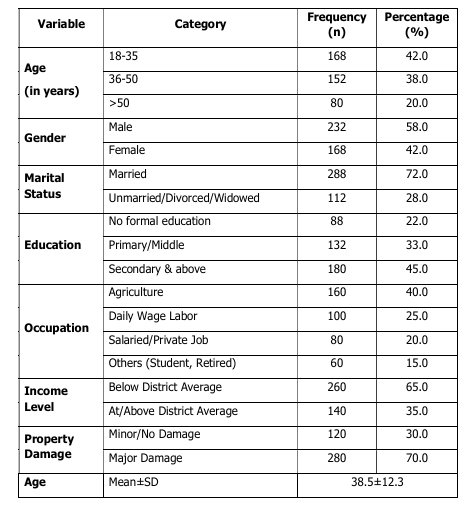
The final sample consisted of 400 flood
survivors. The socio-demographic profile is
presented in Table 1. The mean age of the
participants was 38.5 years (SD = 12.3), with
a range from 18 to 72 years. The majority of
the sample was male (58%) and married
(72%). In terms of education, 45% had
completed secondary school or higher.
Agriculture was the primary occupation for
40% of the participants, followed by daily
wage labour (25%). A significant portion of
the sample (65%) reported a monthly family
income below the district average. Regarding
the impact of the flood, 70% reported major
damage to their home.
Table-2: Frequency of Coping Strategies
Used by Participants (N=400).
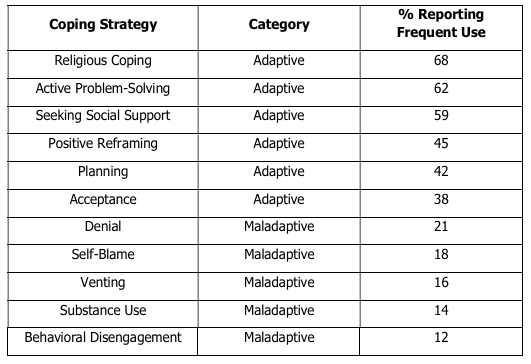
The frequency of use of different coping
strategies, as measured by the Brief COPE, is
detailed in Table 2. The most frequently
adopted strategies fell into the adaptive
category. Religious coping was the most
common, with 68% of participants reporting
that they “often” or “very often” engaged in
prayer or sought spiritual comfort. This was
followed by active problem-solving (62%) and
seeking social support (59%). Positive
reframing (45%) and planning (42%) were
also moderately common. Among the
maladaptive strategies, denial was the most
prevalent, though still relatively low, with 21%
of participants endorsing it. Substance use
(14%) and behavioral disengagement (12%)
were the least common strategies reported.
Table-3: Pearson’s Correlation
Coefficients between Coping, Support,
and Resilience (N=400).
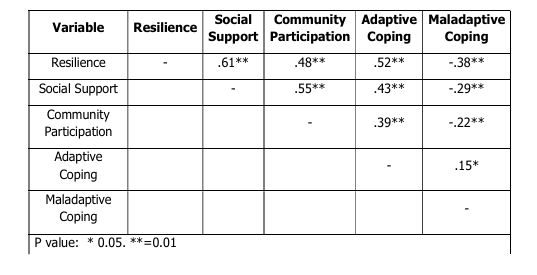
Pearson’s correlation analysis (Table 3)
showed that resilience was positively
associated with social support (r = .61, p <
.01), community participation (r = .48, p <
.01), and adaptive coping (r = .52, p < .01).
This indicates that higher support,
participation, and constructive coping were
linked with greater resilience. Conversely,
resilience was negatively correlated with
maladaptive coping (r = -.38, p < .01),
suggesting that avoidant or harmful coping
lowered resilience. Social support and
community participation were also positively
related, while maladaptive coping showed
consistent negative associations with other
variables. Overall, these findings highlight that
social and adaptive resources enhance
resilience, whereas maladaptive coping
undermines it.
Table-4: Multiple Regression Analysis
Predicting Resilience (N=400).
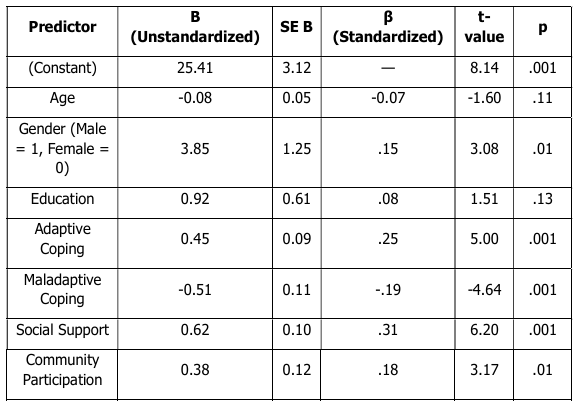
Table-4: shows a multiple linear regression
analysis was conducted to determine the
unique contribution of the predictor variables
to resilience scores. The model included
socio-demographic variables (age, gender,
education), adaptive coping, maladaptive
coping, social support, and community
participation. The overall model was
statistically significant, F(7, 392) = 33.76, p
< .001, and explained 41% of the variance in
resilience scores (Adjusted R² = .41). The strongest significant predictors of resilience
were social support (â=.31, p<.001) and
adaptive coping (â= .25, p<.001). Community
participation was also a significant positive
predictor (â=.18, p<.01). Among the socio
demographic variables, gender (coded
male=1, female=0) was a significant
predictor, with men tending to have higher
resilience scores (â=.15, p<.01). Age and
education were not significant predictors in
the final model when controlling for other
factors. Maladaptive coping was a significant
negative predictor (â=-.19, p<.001).
DISCUSSION
This study plan out to investigate the coping
strategies and resilience of individuals
affected by severe flooding in the Samba
District of Jammu & Kashmir. The findings
provide valuable insights into the psychosocial
dynamics of a disaster-affected community in
a specific cultural context and have significant
implications for disaster management and
mental health policy.
The socio-demographic finding that Male
participants demonstrated significantly higher
resilience scores than females. However, this
finding should be interpreted cautiously as
resilience may be influenced by sociocultural
roles, reporting tendencies, and access to
social resources, is consistent with some
previous disaster literature (e.g., Tolin & Foa,
2006). Although age was examined as a
potential correlate, it did not emerge as a
significant independent factor associated with
resilience in the multivariable model., it did
not emerge as a statistically significant
independent predictor in the regression model
(B=-0.08, p=.11), indicating that its apparent
effect is accounted for by coping and social
support when these variables are controlled.
This could be due to a variety of factors,
including traditional gender roles that may
burden women with greater caregiving and
domestic stressors post-disaster. However,
these findings must be interpreted with
caution, as they may also reflect gender biases
in the measurement of resilience itself. The
fact that gender remained a significant
predictor even after controlling for coping and
support suggests that other unmeasured
factors are at play.
Study revealed that the most striking finding
was the overwhelming reliance on adaptive
coping strategies, with religious coping, active
problem-solving, and seeking social support
being the three most frequently used. The
high prevalence of religious coping (68%)
aligns with research conducted in other South
Asian contexts, where faith and spirituality
often serve as primary resources for
meaning-making and emotional regulation
during crises (Goldmann & Galea, 2014). In
the culturally rich region of Jammu & Kashmir,
turning to prayer, religious gatherings, and
spiritual leaders is not just a personal act but
a communal one, reinforcing social bonds and
a sense of shared destiny. This highlights the
critical importance of incorporating religious
and faith-based organizations into disaster
response frameworks as key partners in
psychosocial support. The positive association
between social support and resilience is
consistent with findings reported by Aldrich
and Meyer (2015), who identified social
capital as a critical determinant of disaster
recovery.
The high use of active problem-solving (62%)
and seeking social support (59%)
demonstrates a proactive and socially
oriented approach to recovery. Survivors were
not passively enduring their situation but were
actively engaged in rebuilding efforts and
leveraging their social networks for both
emotional and instrumental aid. This finding
challenges a narrative of victimhood and
i nstead paints a picture of agency and
resourcefulness. It underscores the resilience
inherent in community structures, where
neighbors, family, and friends form the first line of support.
Conversely, the relatively low use of
maladaptive strategies like denial and
substance use is encouraging. While these
behaviors were present and, as expected,
negatively correlated with resilience, they
were not the norm. This could suggest that
the strong social fabric of the community acts
as a deterrent to socially isolating or harmful
behaviors. Though, the 14% rate of substance
use still warrants attention, as it represents
a vulnerable subgroup that may require
targeted interventions.
The mean resilience score of 61.4 (SD = 12.7)
indicates a moderately high level of resilience
in the sample contextually, Connor & Davidson
(2003) reported a mean CD-RISC score of
80.4 in a general population sample, placing
the present sample’s score of 61.4 in the
l ower-moderate range relative to non
disaster populations, though comparable to
means reported in other post-disaster studies
(range typically 55–65). This is consistent with
the finding that adaptive coping was
prevalent. It suggests that despite the
significant hardship faced, the majority of
individuals possessed the inner and outer
resources to cope effectively. However, the
wide standard deviation also highlights the
substantial variability in resilience,
emphasizing that resilience is not a given but
is distributed unevenly across the population.
The regression analysis provided the most
critical insights by identifying the key
predictors of this resilience. The finding that
social support was the strongest predictor (â
=.31) powerfully confirms the central thesis
of community resilience theories (Norris et al.,
2008). It is not just an individual’s
psychological makeup but the quality of their
connections to others that most robustly
predicts their ability to bounce back. This
aligns with the work of Aldrich and Meyer
(2015), who demonstrated that social capital
is a more powerful predictor of recovery than
physical or financial capital.
The significant contribution of adaptive coping
(â=.25) and community participation (â=.18)
reinforces this. Resilience is an active
process; it is built through doingthrough
solving problems, reaching out to others, and
participating in collective life. These findings
suggest that interventions that simply provide
aid without fostering engagement and self
efficacy may be less effective in the long run.
The negative impact of maladaptive coping (â
=-.19) also serves as a clear indicator that
mental health services need to identify and
address these harmful behaviors early on.
Table-2 show a strong negative correlation
to exist between imposter syndrome and grit
(r=-.485, p<.01), a strong positive correlation
to exist between imposter syndrome and fear
of failure (r=.502, p<.01) and a strong
negative correlation to exist between fear of
failure and grit (r=-.936, p<.01).Here, the
H1a, H1b and H1c are accepted that shows
there would be significant association between
imposter syndrome and grit, imposter
syndrome and fear of failure, and fear of
failure and grit among university students
respectively.
ACKNOWLEDGMENT
The authors express their sincere gratitude
to all the participants who generously shared
their time and experiences during this study.
Special thanks are extended to the local
health workers, community leaders, and
volunteers who facilitated data collection and
supported community engagement efforts.
The authors also acknowledge the guidance
and encouragement provided by institutional
mentors and colleagues throughout the
research process. Finally, heartfelt
appreciation is extended to the organizations
involved in disaster relief and rehabilitation,
whose collaboration made this study possible.
IMPLICATIONS
· Integrate MHPSS in Disaster Plans:
Make mental health and psychosocial
support a key part of disaster
preparedness, with training for
community workers and first
responders.
· Use Community and Religious Networks:
Deliver interventions through trusted
local channels like religious leaders and
community groups to enhance
acceptance.
· Reinforce Social Networks: Design aid
programs that strengthen community cohesion through collective rebuilding
and peer-support initiatives.
· Target Vulnerable Groups: Develop
specific programs for women, older
adults, and those using maladaptive
coping (e.g., women’s circles, elderly
outreach, counseling).
· Promote Adaptive Coping: Introduce
psycho-educational programs to teach
problem-solving, positive reframing, and
stress management skills.
LIMITATION & FUTURE DIRECTION
The cross-sectional design limits causal
interpretation of findings. Data were collected
through self-report measures, which may be
subject to recall and social desirability bias.
Participants were recruited using convenience
sampling from a relief camp, limiting
generalizability to all flood-affected
populations. Community participation was
assessed using a brief study-specific measure
that requires further psychometric validation.
Future longitudinal and mixed-method studies
are recommended to better understand
resilience trajectories following disasters.
Future studies should employ longitudinal
designs to examine changes in coping and
resilience over time. Qualitative approaches
may provide deeper insights into cultural and
religious coping processes. Intervention
studies evaluating community-based
resilience-building programmes are also
warranted.
CONCLUSION
The study demonstrated that adaptive coping
strategies, social support, and community
participation were positively associated with
resilience among flood survivors in Samba
District. Social support emerged as the
strongest factor associated with resilience.
Findings highlight the importance of
strengthening community networks, promoting
adaptive coping skills, and integrating
psychosocial support within disaster
management programmes.
REFERENCES
Aldrich, D. P., & Meyer, M. A. (2015). Social
capital and community resilience.
American Behavioral Scientist, 59(2),
254-269.
Baidhawy, Z. (2015). The role of faith-based
organization in coping with disaster
management and mitigation:
Muhammadiyah’s experience. Journal
of Indonesian Islam, 9(2), 167-194.
Beaglehole, B., Mulder, R. T., Frampton, C. M.,
Boden, J. M., Newton-Howes, G., &
Bell, C. J. (2018). Psychological
distress and psychiatric disorder after
natural disasters: Systematic review
and meta-analysis. The British Journal
of Psychiatry, 213(6), 716-722.
Carver, C. S. (1997). You want to measure
coping but your protocol’s too long:
Consider the Brief COPE. International
Journal of Behavioral Medicine, 4(1),
92-100.
Cicognani, E., Pietrantoni, L., Palestini, L.,
&Prati, G. (2009). Emergency workers’
quality of life: The protective role of
sense of community, efficacy beliefs
and coping strategies. Social
indicators research, 94(3), 449-463.
Connor, K. M., & Davidson, J. R. T. (2003).
Development of a new resilience
scale: The Connor-Davidson
Resilience Scale (CD-RISC).
Depression and Anxiety, 18(2), 76-82.
Cooper, C., Katona, C., Orrell, M., & Livingston,
G. (2008). Coping strategies and
anxiety in caregivers of people with
Alzheimer’s disease: The LASER-AD
study. Journal of Affective Disorders,
106(1-2), 243-249.
Davidson, J. R. T., Payne, V. M., Connor, K.
M., Foa, E. B., Rothbaum, B. O.,
Hertzberg, M. A., &Weisler, R. H. (2005). Trauma, resilience and
saliostasis: Effects of treatment in
post-traumatic stress disorder.
International
Clinical
Psychopharmacology, 20(1), 43-48. .
Goldmann, E., & Galea, S. (2014). Mental
health
consequences
of
disasters. Annual review of public
health, 35(1), 169-183.
Lazarus, R. S., & Folkman, S. (1984). Stress,
appraisal, and coping. Springer.
Mason, V., Andrews, H., & Upton, D. (2010).
The psychological impact of exposure
to floods. Psychology, Health &
Medicine, 15(1), 61-73.
Masten, A. S. (2018). Resilience theory and
research on children and families:
Past, present, and promise. Journal of
Family Theory & Review, 10(1), 12
31.
Meraj, G., Khan, T., Romshoo, S. A., Farooq,
M., Rohitashw, K., & Sheikh, B. A.
(2018, November). An integrated
geoinformatics and hydrological
modelling-based approach for
effective flood management in the
Jhelum Basin, NW Himalaya.
In Proceedings (Vol. 7, No. 1, p. 8).
MDPI.
Norris, F. H., Friedman, M. J., Watson, P. J.,
Byrne, C. M., Diaz, E., &Kaniasty, K.
(2002). 60,000 disaster victims speak:
Part I. An empirical review of the
empirical literature, 1981-2001.
Psychiatry: Interpersonal and
Biological Processes, 65 (3), 207-239.
Norris, F. H., Stevens, S. P., Pfefferbaum, B.,
Wyche, K. F., &Pfefferbaum, R. L.
(2008). Community resilience as a
metaphor, theory, set of capacities,
and strategy for disaster readiness.
American Journal of Community
Psychology, 41(1-2), 127-150.
Oni, O., Harville, E., Xiong, X., & Buekens, P.
(2015). Relationships among stress
coping styles and pregnancy
complications among women exposed
to Hurricane Katrina. Journal of
Obstetric, Gynecologic & Neonatal
Nursing, 44(2), 256-267.
Pargament, K. I. (2001). The psychology of
religion and coping: Theory, research,
practice. Guilford press.
Patel, S. S., Rogers, M. B., Amlôt, R., & Rubin,
G. J. (2017). What do we mean
by’community resilience’? A
systematic literature review of how it
is defined in the literature. PLoS
currents, 9, ecurrents-dis.
Singh, K., & Jha, S. D. (2019). Adaptation and
validation of the Brief COPE Inventory
in Indian context. Indian Journal of
Psychological Medicine, 41(4), 362
367.
Tolin, D. F., &Foa, E. B. (2006). Sex
differences in trauma and
posttraumatic stress disorder: A
quantitative review of 25 years of
research. Psychological Bulletin,
132(6), 959-992.
Windle, G. (2011). What is resilience? A
review and concept analysis. Reviews
in Clinical Gerontology, 21(2), 152
169.
World Health Organization (WHO). (2022).
Mental health and psychosocial
support in emergencies. WHO Press.
Zimet, G. D., Dahlem, N. W., Zimet, S. G., &
Farley, G. K. (1988). The
Multidimensional Scale of Perceived
Social Support. Journal of Personality
Assessment, 52(1), 30-41.
Conflict of interest: None
Role of funding source: None
