The art of review: This narrative review
describes the level of knowledge, awareness,
coverage, utilization and its impact on OOPE,
CHE and Financial Risk. It also elaborates the
challenges experienced by beneficiaries,
HCW’s and health system in the
implementation of PMJAY scheme among
different population and geographical areas.
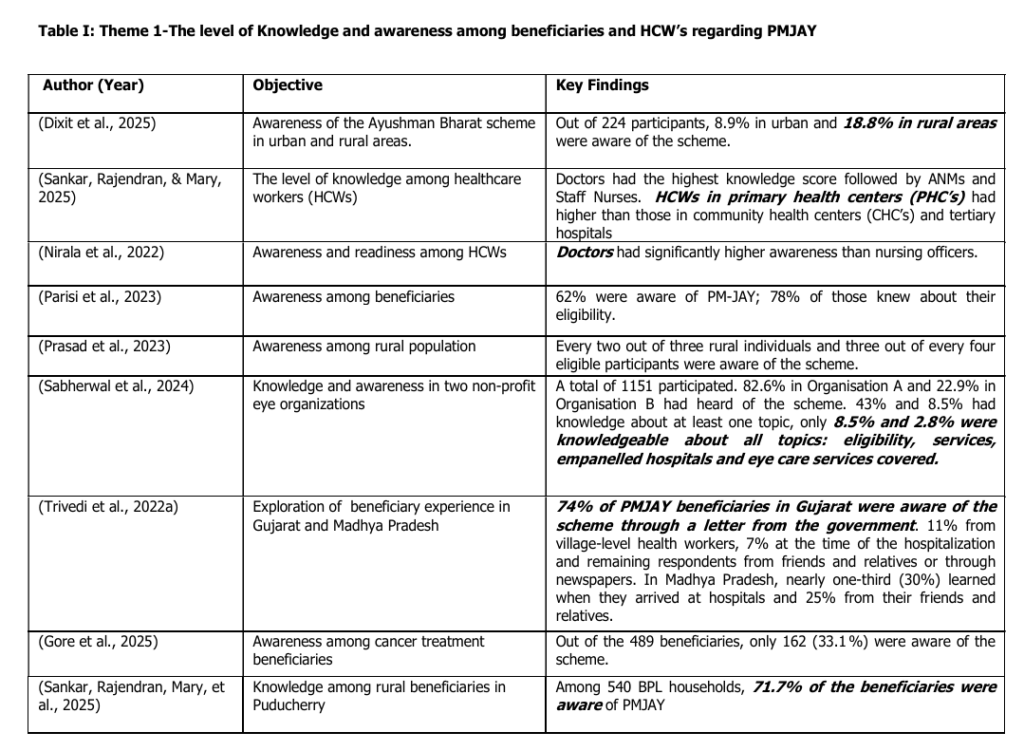
Awareness among urban beneficiaries is not
the optimal level as reported by (Dixit et al.,
2025). Contrasingly, (Prasad et al., 2023) and
(Sankar, Rajendran, Mary, et al., 2025)
revealed that rural awareness was higher and
over 70% of beneficiaries aware of the
scheme. The sources of information regarding
the scheme are vital in spreading awareness.
(Trivedi et al., 2022) identified government
i ssued letters as a primary source for
beneficiary awareness in Gujarat, while social
contacts through friends and relatives were
the source in Madhya Pradesh. It reflects that
multiple communication strategies are
necessary to reach the populations effectively.
Healthcare workers (HCWs), particularly
doctors had higher knowledge score than
beneficiaries, as evidenced by (Sankar,Rajendran, Mary, et al., 2025) and (Nirala et
al., 2022). HCW’s at the primary healthcare
level where knowledge was higher than
community health centers and tertiary care
hospitals. Hence, frontline HCW’s serve as the
first point of contact and can influence
beneficiary awareness and enrollment. The
data from (Sabherwal et al., 2024) revealed
a small fraction were knowledgeable about
all key aspects of the scheme such as
eligibility, covered services and empanelled
hospitals. This finding emphasized awareness
does not relate to comprehensive knowledge
necessary for effective utilization. The low
level of awareness among urban beneficiaries
(Dixit et al., 2025) and the moderate
awareness reported by (Gore et al., 2025)
among cancer treatment patients suggest that
outreach and disease specific awareness
might be required. Socio economic and
informational barriers explain that why eligible
population still unaware or partially aware of
PMJAY.
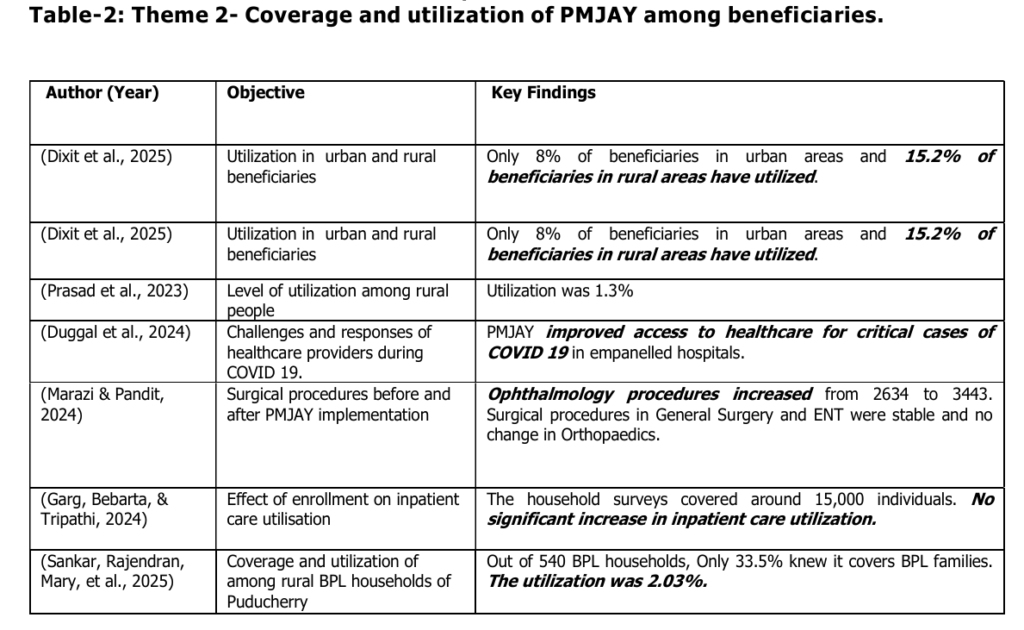
Low utilization rates reported by (Dixit et al.,
2025), (Prasad et al., 2023) and (Sankar,
Rajendran, & Mary, 2025) across urban and
rural populations highlighted that awareness
alone does not ensure the coverage and
utilisation of the scheme. Barriers such as
enrollment issues (eligible without BPL card),
delay in issuing card (verification process),
procedural complexity, HCW’s attitude and
limited healthcare infrastructure were the
reason for beneficiaries to utilise scheme’s
benefits. (Garg et al., 2024) emphasized that
enrollment under PM-JAY does not ensure into
increased inpatient care utilization. Health
system issues include inadequate HCW’s
knowledge; administrative inefficiency and
lack of beneficiary empowerment to navigate
the healthcare system were the reason for
low utilisation. As evidenced by (Duggal et al.,
2024), who reported improved access to
critical COVID-19 care through empanelled
hospitals. This depicts the scheme’s
importance in facilitating timely healthcare
access during crises. (Marazi & Pandit, 2024)
reported PMJAY’s impact on different medical
and surgical procedures. Ophthalmology
surgeries were increased compared to other
procedures. The gaps in other medical and
surgical procedures to be addressed through
targeted policy measures and provider
engagement.
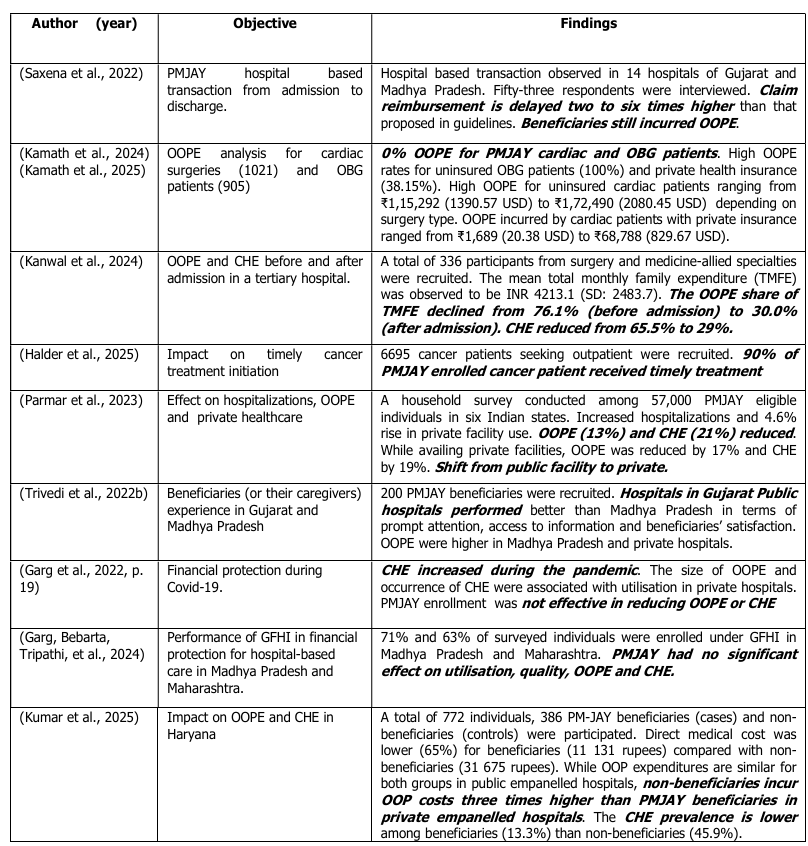
The evidence reviewed presents a nuanced
picture of PMJAY’s impact on healthcare
utilization and financial protection. Several
studies (Kamath et al., 2024, 2025; Kumar et
al., 2025; Parmar et al., 2023) indicate that
PM-JAY effectively reduces OOPE and CHE
among beneficiaries accessing private
empanelled hospitals and specialized care
such as cardiac surgeries and obstetrics
gynecology. Hence, the scheme supports to
offer financial risk protection to vulnerable
populations.(Garg et al., 2022) presented that
scheme does not reduce in OOPE or CHE.
System challenges exist in implementation,
claim processing and accessing care. (Saxena
et al., 2022) stated that delay in claim
reimbursement was the operational
challenges for still occurring OOPE. Regional
disparities like beneficiaries in Gujarat
satisfied with the scheme and reported lower
OOPE compared to Madhya Pradesh. It can
be due to health system capacities,
governance and HCW’s performance. Scheme
facilitates timely access to critical care
especially cancer care (Halder et al.).
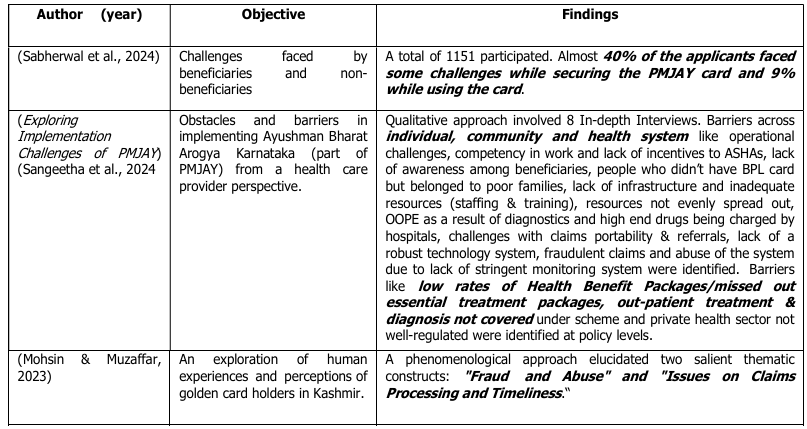
Studies presented administrative and
operational challenges that hinder the
effective implementation and utilization of the
PMJAY. These challenges were from both
beneficiary and provider perspectives.
(Sabherwal et al., 2024) reported that
inefficiencies in beneficiary identification and
card issuing process. (Mohsin & Muzaffar,
2023) captured beneficiary abuse and claim
processing delays. This qualitative insight
reflects not only operational inefficiencies but the emotional and psychological impact on
beneficiaries. (Gore et al., 2025) found that
beneficiaries were dissatisfied due to
incomplete coverage and OOPE. This finding
explains that the current insurance packages
are insufficient for complex conditions like
cancer, with delays in approvals and technical
issues further disturbing treatment access.
Dixit, R., Chauhan, A., & Juneja, K. (2025).
Awareness and Utilization of
Ayushman Bharat Pradhan Mantri Jan
Arogya Yojana (AB-NHPM) among
Beneficiaries of Gautam Buddha Nagar
District: A Comparative Study. Indian
Journal of Community Medicine,
50(1), 213–219. https://doi.org/
10.4103/ijcm.ijcm_728_23
Duggal, B., Kapoor, A., Duggal, M., Maria, K.,
Rayapati, V., Chourase, M., Kumar, M.,
Saunik, S., Gedam, P., &
Subramanian, L. (2024). Cautionary
lessons from the COVID-19 pandemic:
Healthcare systems grappled with the
dual responsibility of delivering
COVID-19 and non-COVID-19 care.
PLOS Global Public Health, 4(11),
e0002035. https://doi.org/10.1371/
journal.pgph.0002035
Garg, S., Bebarta, K. K., & Tripathi, N. (2022).
Household expenditure on non-Covid
hospitalisation care during the Covid
19 pandemic and the role of financial
protection policies in India. Archives of Public Health, 80(1), 108. https://
doi.org/10.1186/s13690-022-00857-8
Garg, S., Bebarta, K. K., Tripathi, N., & Keshri,
V. R. (2024). Impact of Government
Funded Health Insurance on Out-of
Pocket Expenditure and Quality of
Hospital-Based Care in Indian States
of Madhya Pradesh and Maharashtra.
Applied Health Economics and Health
Policy, 22(6), Article 6. https://
doi.org/10.1007/s40258-024-00911-2
Gore, S., Mhamane, S., Jadhav, S., Padvi, N.,
Mhatre, A., Joshi, P., Sawakare, S.,
Samant, V., Chaturvedi, P., Pramesh,
C. S., Gupta, S., & Budukh, A. (2025).
Implementation challenges of
government-funded health schemes
for cancer treatment at Tata Memorial
Centre. Journal of Cancer Policy, 43,
100564. https://doi.org/10.1016/
j.jcpo.2025.100564
Grant, M. J., & Booth, A. (2009). A typology
of reviews: An analysis of 14 review
types and associated methodologies.
Health Information & Libraries Journal,
26(2), 91–108. https://doi.org/
10.1111/j.1471-1842.2009.00848.x
Kamath, S., Sankar Acharya, S., Brand, H.,
Salins, P., Verma, R., Sumit, Dr. K.,
Prabhu, Dr. V., & Kamath, R. (2025).
Out-of-Pocket Expenditure (OOPE) on
Selected Surgeries in the Obstetrics
and Gynaecology Department incurred
by Ayushman Bharat Pradhan Mantri
Jan Arogya Yojana (AB-PMJAY),
Private Health Insurance and
Uninsured Patients in a Tertiary Care
Teaching Hospital in Karnataka state
of India. F1000Research, 13, 1511.
h t t p s :/ / doi. o rg/10.12688/
f1000research.157203.2
Kamath, S., Singhal, N., J, J., Brand, H., &
Kamath, R. (2024). Out-of-Pocket
Expenditure for Selected Surgeries in
t he Cardiology Department for
Ayushman Bharat Pradhan Mantri Jan
Arogya Yojana (AB-PMJAY), Private
Health Insurance, and Uninsured
Patients in a Tertiary Care Teaching
Hospital in Karnataka, India. Cureus.
https://doi.org/10.7759/cureus.62444
Kumar, A. P., Yerram, A., Chugh, Y., Rana, S.,
Mudgal, D., Prinja, S., & V R, M.
(2025). Impact of India’s publicly
funded health insurance scheme on
financial risk protection: A case
control study from Haryana state in
India. BMJ Open, 15(9), e093304.
https://doi.org/10.1136/bmjopen
2024-093304
Marazi, B. H., & Pandit, M. I. (2024). Impact
of Ayushman Bharat Pradhan Mantri
Jan Arogya Yojana on Surgical
Procedure Frequency at a Tertiary
Care Hospital in Kashmir. Journal of
Integrative Medicine and Public
Health, 3(1), 45–50. https://doi.org/
10.4103/JIMPH.JIMPH_8_24
Mohsin, A., & Muzaffar, S. (2023). Exploring
Health Challenges: A Study of Golden
Card Holders under PM-JAY in Kashmir.
In Review. https://doi.org/10.21203/
rs.3.rs-3407180/v1
Nanda, M., & Sharma, R. (2023). A
comprehensive examination of the
economic impact of out-of-pocket
health expenditures in India. Health
Policy and Planning, 38(8), Article 8.
https://doi.org/10.1093/heapol/
czad050
Narayanan, N., & Kodali, P.B. (2020). Out of
Pocket Health Expenditure and
Catastrophic Health Expenditure
among the Beneficiaries of
Comprehensive Health Insurance
Scheme in Kerala.
Nirala, S. K., Kumar, P., Naik, B. N., Pandey,
S., Singh, C., Rao, R., & Bhardwaj, M.
(2022). Awareness and Readiness To
Implement the Pradhan Mantri Jan Arogya Yojana: A Cross-Sectional
Study Among Healthcare Workers of
a Tertiary Care Hospital in Eastern
India. Cureus. https://doi.org/
10.7759/cureus.24574
Parmar, D., Strupat, C., Srivastava, S.,
Brenner, S., Parisi, D., Ziegler, S.,
Neogi, R., Walsh, C., & De Allegri, M.
(2023). Effects of the Indian National
Health Insurance Scheme (PM-JAY) on
Hospitalizations, Out-of-pocket
Expenditures and Catastrophic
Expenditures. Health Systems &
Reform, 9(1), Article 1. https://
d o i . o r g / 1 0 . 1 0 8 0 /
23288604.2023.2227430
Prasad, S. S. V., Singh, C., Naik, B. N., Pandey,
S., & Rao, R. (2023). Awareness of
the Ayushman Bharat-Pradhan Mantri
Jan Arogya Yojana in the Rural
Community: A Cross-Sectional Study
in Eastern India. Cureus. https://
doi.org/10.7759/cureus.35901
Sabherwal, S., Sood, I., Khurana, A.,
Chauhan, L., Saini, S., Shroff, K., &
Majumdar, A. (2024). Awareness,
knowledge and challenges faced by
beneficiaries and non-beneficiaries of
Ayushman Bharat – Pradhan Mantri
Jan Arogya Yojana with special
reference to eyecare in three districts
of Uttar Pradesh state: A cross
sectional study. Journal of Family
Medicine and Primary Care, 13(8),
2892–2899. https://doi.org/10.4103/
jfmpc.jfmpc_1678_23
Sankar, G. K., Rajendran, P., & Mary, J. J. F.
(2025). Assessing knowledge and
awareness of Pradhan Mantri Jan
Arogya Yojana (PMJAY) scheme among
healthcare workers in primary
secondary and tertiary healthcare
facilities—A cross-sectional study.
Journal of Indira Gandhi Institute of
Medical Sciences, 11(2), 153–158.
h t t p s : / / d o i . o r g / 1 0 . 4 1 03 /
jigims.jigims_26_25
Sankar, G. K., Rajendran, P., Mary, J. J. F.,
Lokeshmaran., A., Dakshinamurthy, S.,
Sugumaran, A., & Sundararajan, T.
(2025). Unlocking universal health
coverage: Insights from a community
based explanatory sequential mixed
method study on Ayushman Bharat
Pradhan Mantri Jan Arogya Yojana
scheme in Rural Puducherry. Journal
of Family Medicine and Primary Care,
14(8), 3427–3433. https://doi.org/
10.4103/jfmpc.jfmpc_340_25
Saxena, A., Trivedi, M., Shroff, Z. C., &
Sharma, M. (2022). Improving
hospital-based processes for effective
implementation of Government funded
health insurance schemes: Evidence
from early implementation of PM-JAY
i n India. BMC Health Services
Research, 22(1), 73. https://doi.org/
10.1186/s12913-021-07448-3
Sinha, R., Chatterjee, K., Nair, N., & Tripathy,
P. (2016). Determinants of Out-of
Pocket and Catastrophic Health
Expenditure: A Cross-sectional Study.
British Journal of Medicine and
Medical Research, 11(8), 1–11.
https://doi.org/10.9734/BJMMR/2016/
21470
Trivedi, M., Saxena, A., Shroff, Z., & Sharma,
M. (2022). Experiences and
challenges in accessing hospitalization
i n a government-funded health
insurance scheme: Evidence from
early implementation of Pradhan
Mantri Jan Aarogya Yojana (PM-JAY)
in India. PLOS ONE, 17(5), e0266798.
h t t p s : / / d o i . o r g / 1 0 . 1 3 71 /
journal.pone.0266798