

Indian Journal of Health Social Work
(UGC CARE List Journal)
HEALTH AND WELL-BEING: A SOCIAL WORK PERSPECTIVE
Anupam Kumar Verma1 & Muskan Bharti2
1Assistant Professor, Department of Social Work, Mahatma Gandhi Central University, Bihar,
District- East Champaran, Bihar- 845401, 2Guest Faculty, Department of Social Work Mahatma
Gandhi Central University, Bihar
Correspondence: Anupam Kumar Verma, e-mail: akv.msw@gmail.com
ABSTRACT
Health is also becoming more accepted as a multidimensional concept that is not only influenced
by biological aspects and medical treatment but also by social, economic and environments in
which individuals reside. The paper discusses the social work concept of health as it puts into
consideration the role of social determinants, health inequalities and social justice in interpreting
health outcomes. In the paper, the author discusses the importance of social work within health
care environments with an emphasis on the interventions at the individual, group, and community
levels. It talks about the main approaches of social work, which involve casework, group work
and community organisation, and touches on ethics, directing the practice of health professionals.
Resource constraints, role confusion, emotional requirements, and systems barriers, which health
social workers face, are also critically discussed. The paper suggests that social work is crucial
in the context of reducing health inequalities and building health systems; hence, it takes a
holistic and humanistic approach. Social work approach combines psychosocial support with
advocacy and community involvement, thus covering the short-term and long-term health
requirements and structural issues. The conclusion of the paper restates the argument about
the necessity of having inclusive and equitable health systems that acknowledge social work as a
constituent of health care. The policies of health that should be strengthened focus on the social
work practice in order to have the comprehensive and sustainable health and well-being of all.
Keywords: Health and Well-Being, Social Work Perspective, Social Determinants of Health,
Holistic Health, Social Justice.
Submitted: 09.10.2025 Revised: 05.11.2025 Accepted: 24.11.2025 Published: 28.01.2026
How to cite this article: Verma, A. K., & Bharti, M. (2025). Health and well-being: A social
work perspective. Indian Journal of Health Social Work, 7(2), 15-26.
INTRODUCTION
The concept of health is mostly given out as
the lack of disease. This is the limited
perspective that does not reflect the realities
that are complex in determining the well-being
of people (Engel, 1977). People are not
healthy beings but instead, their health itself
is highly affected by their social, economic,
environmental and cultural status (Cacioppo
and Hawkley, 2003). Poverty, education, family
support, gender relations, employment and service access are considered the factors that
define who can be healthy and who can be
prone to illness (Vlassoff, 2007; Mechanic and
Tanner, 2007). It is important to realise these
interacting influences in order to come up
with a more holistic perspective on health.
The traditional biomedical model is very
general with diagnosis, treatment, and cure
with little regard to the larger social context
of illness (Engel, 2012). Although medical
interventions play a critical role, they cannot
only solve the underlying causes of most
i l l nesses (Hawe, 2015). Another and
supplementary approach is social work which
considers health as a product of social
relationships, structural conditions and
experiences in life. This school of thought
f ocuses on prevention, psychosocial
assistance, empowerment, and social justice
as well as medical treatment (Green and
McDermott, 2010).
Considering the social work perspective,
health is not just a clinical outcome but a
human right and dignity issue (Becker, 2021,
Auslender, 2001). The health disparities in
both access and outcome are indicative of
underlying social disparities and that is why
health is a significant field of concern when it
comes to social work practice and policy.
Social workers deal with the individuals,
families, groups and communities so that they
can minimise the barriers and enhance coping
skills as well as promote individuals to have
fair health systems (Auslander, 2001).
This paper will discuss the social perspective
of health by understanding the social aspect
of health, the role of social workers in the
health context and the need to take care of
structural inequalities. Through holistic and
humanistic approach, the article brings to the
fore the role of social work in promoting
inclusive, equitable and sustainable health and
well-being of all people.
The Social Approach to the Concept of
Health
A social approach to health acknowledges the
fact that material health is largely linked with
social interaction, psychological, cultural
stability, and financial stability (Eckersley,
2001). The perception that people have about
being described as healthy is not always
similar across societies, communities, and
various life phases that represent different
social values and experiences (Zautra et al.,
2010).
In this perspective, all social situations in
daily life such as food supply, housing,
sanitation, education, employment and family
services are influential in health. These
elements relate with individual behaviours and
biological states to give rise to varying health
results. Two persons with the same medical
condition might also be subjected to different
health outcomes, depending on their social
support systems, resource availability, and
capacity to handle stress (Morcillo et al.,
2019). Therefore, health cannot exist outside
of the social realities that define the choice
and the opportunity of individuals (Williams,
2003).
The social approach also places emphasis on
the impact of culture and social norms on the
health practices and beliefs. The cultural
perceptions have an impact on the way
individuals perceive sickness, the places and
the times they seek medical attention as well
as the effectiveness with which they executed
their treatment plans (Vaughn et al., 2009).
Social stigma, discrimination, and exclusion
may further affect health by putting services
out of reach and undermining social ties. In
this respect, health is more of a social product
and a personal experience (Stangl et al.,
2019).
The social perspective considers health to be
dynamic and not a static state. It is concerned
with the capability of people and communities
to be able to adapt, cope and live productively i n their social environment. Social
relationships, networks in the community and
organisations that support, contribute
significantly to the well-being and resilience
(Zautra et al., 2010).
Using a social approach, health is considered
a collective responsibility which extends
beyond the healthcare system. It suggests
joint work in the social, economic, and policy
spheres to establish the conditions under
which individuals could lead healthy and
decent lives (Sacks el al., 2019). This
realisation constitutes the requirement of
social work practice in health that aspires to
meet the needs of the individuals as well as
the greater social systems that influence
health (Gough 2004).
The Social Determinants of Health
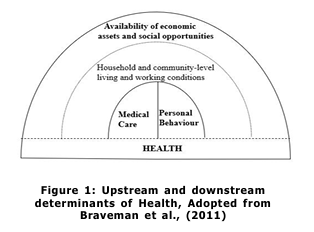
As it has been stated in the section above,
biological determinism and medical attention
are not the only factors that influence health
outcomes but also the social factor under
which individuals are born, raised, live, work
and age (Braveman et al., 2011). All these
factors, commonly known as the social
determinants of health, have an impact on the
capacity of people to ensure well-being,
access resources, and be exposed to risks
(Ferrer, 2018). The knowledge of these factors
is not only important in the social work
perspective since it demystifies the varied
health patterns across the communities and
social groups.
One of the greatest determinants of health is
economic status. The income level influences
accessibility to healthy food, good housing,
proper education, and health facilities (James,
1997). Simultaneously, education is
significant in the process of molding health
consciousness and life prospects.
Environmental factors including social and
physical environments also affect health.
Gender, caste, ethnic, and social exclusion
inequalities are other factors that influence
health experiences, particularly in societies
that are characterised by structural inequality.
Stigma and discrimination may restrict access
to care and make people unwilling to find
prompt support. They are often combined in
a way that certain groups are more
susceptible to health issues due to these kinds
of socioeconomic disadvantages (Nandi and
Schneider, 2014).
Viewing health in the perspective of social
determinants, one is easily able to realise that
health problems are never failures of an
individual but rather the consequence of a
more extensive social construct. These
determinants require collective action, policy
i nterventions and community-based
approaches (Williams, 2003). Social work is
not only important in identifying and mitigating
such underlying social problems because of
its insensitivity to equity, empowerment, and
social justice (Craig, 2002).
Social Justice and Health Inequality
Health inequality can be defined as the unfair
distribution of health outcomes, access to
health care and health status of various
categories of the population. The existence
of such disparities is not accidental, but, in
fact, it is closely intertwined with the political,
social, and economic regimes that advantage
certain groups of people at the expense of
others (McCartney et al., 2019). In terms of
social work, this kind of disparity is so unfair
in the fact that it is not due to individual decisions but exclusively to various
circumstances of prevention and systematic
social occurrences (Lundy, 2004).
Health inequalities are commonly linked to
income, education, gender, caste, region and
social identity. Besides sickness, malnutrition,
disability, and premature death have higher
rates in the marginalised communities, there
are usually barriers posed to access to high
quality healthcare. Lack of information,
financial constraints, discrimination and
paucity of health facilities further contribute
to the existence of these gaps. These trends
show that inequalities in the field of health
are a manifestation of greater socioeconomic
injustices (Ahmad and Mahapatro, 2023;
Kapilasharmi et al., 2015).
The social justice in health is centered on
equity, fairness, and equal opportunity to
achieve the maximum level of health by all
people (Ruger, 2004). It requires the
recognition of health as a fundamental human
right, and not a privilege (Hyden, 2012).
Socially equitable health care can serve
disadvantaged populations by eradicating
structural, enhancing accessibility and
affordability of care, and promoting inclusive
policies (Butkus, 2020).
Socially, there is need to focus on health
disparities through both the intervention of a
system and through direct practice. Social
workers help individuals and families to
overcome barriers to care, access healthcare
systems and to manage sickness at a micro
level. To fight unfair practices and promote
equitable allocation of health resources, they
also participate in community mobilisation,
macro-level policy-making (McGregor et al.,
2018; Steketee et al., 2017; Auslander, 2016).
Socially justifying health also entails the
empowerment of communities to take part in
decision making processes that have impacts
on their well-being. Interventions are
responsive and sustainable when individuals
increase their voices in the formulation of
health policies and services. With this, to
decrease health disparities, it is necessary to
implement not medical interventions but social
change, focused on the establishment of fair
and equal opportunities to health and well
being (Varcoe et al., 2014; Ruger, 2004).
The Method of Social Work in Health
Healthcare social work is based on various
approaches and methods that are aimed at
meeting the complex and interdependent
needs of individuals, families, groups and
communities. These methods acknowledge
that health issues are psychologically, socially
and environmentally affected and thus they
need intervention other than medical care.
The combination of various practices helps
social workers to encourage comprehensive
care and well-being sustainability
(SocialWorkLicensure.Org, 2017, cited in
Keaton, 2022).
Casework is an inherent approach to health
environments, and it is aimed at resolving
personal issues. Casework helps a social
worker to study the social history of a person,
emotional status, family dynamics, and
available resources to comprehend their
impact on health. The individuals are assisted
in coping with illness, supporting treatment,
and making informed decisions regarding their
health through counselling, crisis intervention,
and care planning (McCoyed et al., 2016; Allen
and Spitzer, 2015).
The main way of practising social work is also
group work (Schwartz, 1986). Patients with
a chronic condition, mental health issues, and
common life experiences can also enjoy the
benefit of learning and emotional support
within a support group (Worral et al., 2018).
Groups in health education have a significant
role to play in creating awareness, advising
healthy behaviours and ensuring that stigmas
of some conditions are eliminated. The group
environment helps to feel a sense of belonging
and strength, which may have a beneficial impact on the resilience and recovery (Elwyn
et al., 2018).
These community-based strategies are
essential for addressing health issues on a
larger scale (Wilson et al., 2012). Social
workers involve communities in the process
of identifying health-related needs, mobilising
local resources, and health action and health
planning. This approach is beneficial in
facilitating supportive environments that
support preventive and promotive healthcare
through awareness programs and capacity
building, as well as community leadership
development (Allen and Spitzer, 2015; Gehlert
and Browne, 2011; NASW, 2016).
Besides the above, social workers usually
utilise integrated, strengths-based, and
systems-oriented approaches. All these
approaches aim at the abilities of people and
communities as opposed to their weaknesses
and include the relationship between people
and their surroundings. Through these various
practices and strategies, social work within
the healthcare can guarantee holistic work
interventions that go beyond the direct health
issues to the underlying societal issues that
influence well-being (Miller et al., 2017).
The Role of Social Workers in Healthcare
Social workers can perform various roles to
benefit the client, as described below:
Psychosocial Assessment
Social workers determine the emotional, family, financial, and social status of patients to know the factors influencing illness and recovery.
Social workers determine the emotional, family, financial, and social status of patients to know the factors influencing illness and recovery.
Emotional Support and Counselling
They also offer counselling to patients and families to enable them handle stress, chronic diseases, fear, disability, and problems associated with treatment.
They also offer counselling to patients and families to enable them handle stress, chronic diseases, fear, disability, and problems associated with treatment.
Patient Advocacy
The social workers safeguard the rights of the patients through obtaining informed consent, confidentiality, equitable treatment, and access to relevant health services.
The social workers safeguard the rights of the patients through obtaining informed consent, confidentiality, equitable treatment, and access to relevant health services.
Connection with Resources and Welfare
Schemes
They link patients to government health schemes, financial assistance, insurance, Non Governmental Organisation and community based support systems.
They link patients to government health schemes, financial assistance, insurance, Non Governmental Organisation and community based support systems.
Discharge Planning and Continuity of Care
Social workers assist in the discharge planning, which includes the coordination of the follow up treatment, rehabilitation services, home care, and family preparedness.
Social workers assist in the discharge planning, which includes the coordination of the follow up treatment, rehabilitation services, home care, and family preparedness.
Crisis Intervention
They also step in during medical
emergencies, suicidal attempts, domestic violence, trauma or unexpected diagnosis, which involves immediate psychosocial assistance. Vulnerable and Marginalised Groups Support Social workers guarantee that care is inclusive to children, the elderly, women, and persons with disabilities and the poor.
emergencies, suicidal attempts, domestic violence, trauma or unexpected diagnosis, which involves immediate psychosocial assistance. Vulnerable and Marginalised Groups Support Social workers guarantee that care is inclusive to children, the elderly, women, and persons with disabilities and the poor.
Health Education and Awareness
They train patients and communities on disease prevention, adherence to treatment, mental health, hygiene, and lifestyles (Tadic et al., 2020; Browne, 2019; Ashcroft et al., 2018).
They train patients and communities on disease prevention, adherence to treatment, mental health, hygiene, and lifestyles (Tadic et al., 2020; Browne, 2019; Ashcroft et al., 2018).
Social Work, Values and Ethics
Healthcare social work practice is grounded on professional values and ethics. The values help social workers to make responsible choices, uphold professional integrity, and provide respectful and fair practice with individuals, families, and communities. Ethical
Healthcare social work practice is grounded on professional values and ethics. The values help social workers to make responsible choices, uphold professional integrity, and provide respectful and fair practice with individuals, families, and communities. Ethical
Social Work, Values and Ethics
Healthcare social work practice is grounded on professional values and ethics. The values help social workers to make responsible choices, uphold professional integrity, and provide respectful and fair practice with individuals, families, and communities. Ethical behaviour is especially significant in accounting situations in a healthcare environment, where a person can feel vulnerable (Banks, 2020). One of the basic ethics of social work is respect of dignity and worth of the person. Social workers do not perceive individuals in terms of cases and diagnoses, but as individuals. This principle includes the recognition of the experiences, beliefs, cultural backgrounds of the clients and treating them with empathy and without judgment. It also includes counter instructive behaviours within health systems that marginalise and dehumanise individuals (Saleebey, 2002; IFSW, 2018). Self-determination is another critical professional ethics that has focuses on the right of people to make informed choices regarding their lives and health. The social workers do not challenge the decisions made by their clients even when they do not follow the opinions of the experts but help them to understand their options and consequences. It is associated with this concept, which implies advancing autonomy in healthcare and informed consent (IFSW, 2018). Privacy and confidentiality are critical with regard to ethical duties of health-related social work (Reamer, 2018). Social workers receive sensitive personal information, and they must ensure that neither they abuse it nor disclose it unauthorisedly. Confidentiality encourages trust and makes individuals feel free to seek assistance. According to the requirements of ethics and the law, social workers should find the golden mean between the principles of confidentiality and the need to ensure that the person is not exposed to harmful effects (NASW, 2021). Professional competence and accountability is another vital element of ethics. The social workers are supposed to work within the boundaries of their profession, they are supposed to learn the skills required and they are supposed to have the latest information. Social workers can offer effective and responsible healthcare assistance with the help of cultural sensitivity, ethical reflection, and adherence to the professional standards (IFSW, 2018). All these ethics, considered collectively, help to ensure that the social work practice in the health-related field is humanistic, rights based, and socially just, hence promoting moral and compassionate medical care (Gehlert and Browne, 2011).
Healthcare social work practice is grounded on professional values and ethics. The values help social workers to make responsible choices, uphold professional integrity, and provide respectful and fair practice with individuals, families, and communities. Ethical behaviour is especially significant in accounting situations in a healthcare environment, where a person can feel vulnerable (Banks, 2020). One of the basic ethics of social work is respect of dignity and worth of the person. Social workers do not perceive individuals in terms of cases and diagnoses, but as individuals. This principle includes the recognition of the experiences, beliefs, cultural backgrounds of the clients and treating them with empathy and without judgment. It also includes counter instructive behaviours within health systems that marginalise and dehumanise individuals (Saleebey, 2002; IFSW, 2018). Self-determination is another critical professional ethics that has focuses on the right of people to make informed choices regarding their lives and health. The social workers do not challenge the decisions made by their clients even when they do not follow the opinions of the experts but help them to understand their options and consequences. It is associated with this concept, which implies advancing autonomy in healthcare and informed consent (IFSW, 2018). Privacy and confidentiality are critical with regard to ethical duties of health-related social work (Reamer, 2018). Social workers receive sensitive personal information, and they must ensure that neither they abuse it nor disclose it unauthorisedly. Confidentiality encourages trust and makes individuals feel free to seek assistance. According to the requirements of ethics and the law, social workers should find the golden mean between the principles of confidentiality and the need to ensure that the person is not exposed to harmful effects (NASW, 2021). Professional competence and accountability is another vital element of ethics. The social workers are supposed to work within the boundaries of their profession, they are supposed to learn the skills required and they are supposed to have the latest information. Social workers can offer effective and responsible healthcare assistance with the help of cultural sensitivity, ethical reflection, and adherence to the professional standards (IFSW, 2018). All these ethics, considered collectively, help to ensure that the social work practice in the health-related field is humanistic, rights based, and socially just, hence promoting moral and compassionate medical care (Gehlert and Browne, 2011).
Health Social Work Practice Issues
There are a number of challenges in social
work practice in the context of health settings,
which influence the effectiveness and viability
of interventions. All these difficulties are
supported by structural constraints,
institutional constraints and the intricacy of
health-related issues. It is necessary to
understand these challenges in order to
reinforce social work practice in healthcare
systems (Gardner and Zodikoff, 2003).
A shortage of resources, such as lack of
sufficient staffing, financing and a deficiency
of infrastructure, is one of the greatest
challenges. Social workers have busy
schedules and have to cope with numerous
cases, which do not provide time to evaluate,
follow-up, preventive work. The lack of
resources may limit the provision of support
services, and it is hard to address the needs
of various patients and populations, which is
especially true in the context of community
health (Dgielewski and Holliman 2019).
Emotions and ethical issues are the other
challenges that health social workers face in
their practice. Working with chronically ill,
disabled, traumatised, or end-of-life patients
may have an emotional toll and result in stress
and emotional burnout. The moral principles,
including the confidentiality and autonomy of
the client, and the institutional policies and
l egal demands also contribute to the
complexity of the practice (Reamer, 2018). The other major issue is the ignorance and
not acknowledgment of social work role in
healthcare teams. This can be perceived as a
lack of involvement in making decisions and
role ambiguity in social work in some
environments, where medical treatment is
considered paramount to the social work. It
may decrease the possibility of
interdisciplinary cooperation and make it
difficult to integrate psychosocial care with
health services (Ambrose-Miller & Ashcroft
2016; Dziegielewski and Holliman 2019).
There are also challenges of social and
cultural barriers. Stigmatising of mental
illness, HIV/AIDS, disability or even some
social identity may deter anyone to seek help
or stick to treatment. The communication
between the social workers and the service
users can be hindered by language barriers,
cultural beliefs, and poor health literacy
(Ministry of Health and Family Welfare, 2014).
Finally, social work interventions are often
constrained at the policy level and in the
system as a whole. Poor health policies,
disjointed services, and poor coordination
among sectors may undermine efforts in the
social determinants of health. The
organisational support, policy change, capacity
building, and increased appreciation of social
work as an inseparable part of healthcare are
needed to address these challenges (Marmot
et al., 2008).
Way Forward: Social Work in the Field of
Health Strengthening
Elaborating on the discussion above, the
following recommendations are meant to
improve social work practice at the health
care facilities. These suggestions are based
on the available literature, specifically Gehlert
and Browne (2011), Giles (2007), Zheng et
al. (2021), and Thomas and Roy (2024).
his can be accomplished by adopting a Multi
Level Approach
Enhancement of practice social work in health
settings, needs to be coordinated on
individual, institutional, community and policy
levels. The clinical level is not the best
approach to health problems but must be
supplemented with social, economic, and
environmental factors that affect well-being.
Capacity Building and Lifelong Professional
Training
The practice requires continuous education in the field of public health, mental health, health policies, research skills, and technology utilisation. Periodic trainings are a way of keeping social workers abreast and receptive to emerging health issues.
The practice requires continuous education in the field of public health, mental health, health policies, research skills, and technology utilisation. Periodic trainings are a way of keeping social workers abreast and receptive to emerging health issues.
Enhancing Fieldwork and Practice-based
Learning
Practical skills are developed through enhanced field work practice in hospitals, community health centres as well as in public health programmes. Interdisciplinary learning fosters cooperation with doctors and nurses as well as other allied professionals in delivering holistic care.
Practical skills are developed through enhanced field work practice in hospitals, community health centres as well as in public health programmes. Interdisciplinary learning fosters cooperation with doctors and nurses as well as other allied professionals in delivering holistic care.
Inclusion of Social Work in Health Systems
The social workers must play an active role in designing, implementing and evaluating health programmes. The definition of roles and institutional acknowledgment can make psychosocial care an aspect of health services.
The social workers must play an active role in designing, implementing and evaluating health programmes. The definition of roles and institutional acknowledgment can make psychosocial care an aspect of health services.
Community Involvement and Empowerment
The involvement of communities in identifying health needs and designing social work interventions will encourage ownership and sustainability. The social workers also enable leadership in the community, strengthen health awareness and promote preventive and promotional health programs.
The involvement of communities in identifying health needs and designing social work interventions will encourage ownership and sustainability. The social workers also enable leadership in the community, strengthen health awareness and promote preventive and promotional health programs.
The Social Justice Orientation and Policy Advocacy
Social workers are significant in raising social determinants of health and promoting fair health policies. They can make a difference through the involvement of the policymakers and the civil society organisations in making changes that can make healthcare more accessible and affordable.
Social workers are significant in raising social determinants of health and promoting fair health policies. They can make a difference through the involvement of the policymakers and the civil society organisations in making changes that can make healthcare more accessible and affordable.
Application of Research and Evidence-Based
Practice
Enhancing research abilities will empower social workers to record the outcomes of their practices, reveal identified service gaps, and make contributions to health planning. Evidence-based interventions make the social work practice more effective and credible.
Enhancing research abilities will empower social workers to record the outcomes of their practices, reveal identified service gaps, and make contributions to health planning. Evidence-based interventions make the social work practice more effective and credible.
Rights-Based and Holistic Practice
The human rights and approaches that focus on human rights and dignity will help in making sure that equality, inclusion, and ethical values are observed in health services. Holistic practice is concerned with physical, psychological, social and cultural aspects of health.
The human rights and approaches that focus on human rights and dignity will help in making sure that equality, inclusion, and ethical values are observed in health services. Holistic practice is concerned with physical, psychological, social and cultural aspects of health.
CONCLUSION
In order to emphasise the fact that health is a complex term that is determined by social,
economic, cultural, and environmental factors,
this paper views health through the lens of
social work. It focused on issues of how
structural inequities, health disparities and
social factors can influence health outcomes,
often making vulnerable populations more
susceptible. It also described the various
functions, strategies, and ethics of social work
i n the healthcare field and obstacles
encountered in the field, as well as the
necessity of enhanced systems and
capabilities.
The social work approach is the only way of
attaining holistic health. The social work
approach recognises individuals as
components of families, community, and social
structures, unlike approaches that are very
medical. It incorporates clinical care with
psychosocial support, empowerment,
prevention and advocacy, thus improving both
short-term health issues and long-term social
issues that influence health. Such a plan
makes medical care focus on social justice,
human rights, and dignity rather than disease
management.
Inclusive, equitable and non-discriminatory
health systems are becoming requirements.
This can be accomplished through more
i nterdisciplinary collaboration, policies
covering social inequalities, and more re
evaluation of social work as an essential
element of healthcare. With empowered
social work practice in health systems, one
can shift towards a paradigm of
compassionate, accessible, and equitable
healthcare to all members of society.
REFERENCES
Allen, K. M., & Spitzer, W. J. (2015). Social
work practice in healthcare: Advanced
approaches and emerging trends.
Ambrose-Miller, W., & Ashcroft, R. (2016).
Challenges faced by social workers as
members of interprofessional
collaborative
health
care
teams. Health & social work, 41(2),
101-109.
Ashcroft, R., McMillan, C., Ambrose-Miller, W.,
McKee, R., & Brown, J. B. (2018). The
emerging role of social work in primary
health care: A survey of social
workers in Ontario family health
teams. Health & Social Work, 43(2),
109-117.
Auslander, G. (2001). Social work in health
care:
What
have
we
achieved?. Journal of Social
Work, 1(2), 201-222.
Auslander, G. K. (2016). Outcomes of social
work intervention in health care settings. In Behavioral Social Work in
Health Care Settings (pp. 31-46).
Routledge.
Banks, S. (2020). Ethics and values in social
work. Bloomsbury Publishing.
Becker, A. (2021). Human dignity through
action: Transformative human rights
education and social work. Journal of
human rights and social work, 6(3),
173-182.
Braveman, P., Egerter, S., & Williams, D. R.
(2011). The social determinants of
health: coming of age. Annual review
of public health, 32(1), 381-398.
Browne, T. (2019). Social work roles and
healthcare settings. Handbook of
health social work, 21-37.
Butkus, R., Rapp, K., Cooney, T. G., Engel, L.
S., & Health and Public Policy
Committee of the American College of
Physicians*. (2020). Envisioning a
better US health care system for all:
reducing barriers to care and
addressing social determinants of
health. Annals
of
i nternal
medicine, 172(2_Supplement), S50
S59.
Cacioppo, J. T., & Hawkley, L. C. (2003). Social
isolation and health, with an emphasis
on underlying mechanisms.
Perspectives in biology and medicine,
46(3), S39-S52.
Craig, G. (2002). Poverty, social work and
social justice. British Journal of Social
Work, 32(6), 669-682.
Dziegielewski, S. F., & Holliman, D. C. (2019).
The changing face of health care
social work: Opportunities and
challenges for professional practice.
Eckersley, R. (2001). Culture, health and well
being. The social origins of health and
well-being, 51-70.
Elwyn, G., Greenhalgh, T., & Macfarlane, F.
(2018). Groups: a guide to small
group work in healthcare,
management, education and research.
CRC Press.
Engel, G. L. (1977). The need for a new
medical model: a challenge for
biomedicine. Science, 196(4286),
129-136.
Engel, G. L. (2012). The need for a new
medical model: a challenge for
biomedicine. Psychodynamic
psychiatry, 40(3), 377-396.
Ferrer, R. L. (2018). Social determinants of
health. In Chronic illness care:
Principles and practice (pp. 435-449).
Cham: Springer International
Publishing.
Gardner, D. S., & Zodikoff, B. D. (2003).
Meeting the Challenges of Social
Work Practice in Health Care and
Aging. Social Work and Health Care
in an Aging Society: Education, Policy,
Practice, and Research, 377.
Gehlert, S., & Browne, T. (Eds.).
(2011). Handbook of health social
work. John Wiley & Sons.
Ghodajkar, P., & Choudhary, K. K. (2022).
Health Inequalities—An Embodiment
of Caste-Based Inequalities.
In Mapping
Identity-Induced
Marginalisation in India: Inclusion and
Access in the Land of Unequal
Opportunities (pp.
363-394).
Singapore: Springer Nature
Singapore.
Giles, R., Gould, S., Hart, C., & Swancott, J.
(2007).
Clinical
priorities:
Strengthening social work practice in
health. Australian Social Work, 60(2),
147-165.
Gough, I. (2004). Human well-being and social
structures: Relating the universal and
the local. Global social policy, 4(3),
289-311.
Green, D., & McDermott, F. (2010). Social
work from inside and between
complex systems: Perspectives on person-in-environment for today’s
social work. British Journal of Social
Work, 40(8), 2414-2430.
Hawe, P. (2015). Lessons from complex
i nterventions
t o
i mprove
health. Annual review of public
health, 36(1), 307-323.
Hayden, P. (2012). The human right to health
and
the
struggle
for
recognition. Review of International
Studies, 38(3), 569-588.
International Federation of Social Workers.
(2018). Global social work statement
of ethical principles. IFSW. Retrieved
from https://www.ifsw.org/global
social-work-statement-of-ethical
principles/ on 12/12/2025.
James, W. P. T., Nelson, M., Ralph, A., &
Leather, S. (1997). Socioeconomic
determinants of health: the
contribution of nutrition to inequalities
in health. Bmj, 314(7093), 1545.
Kapilashrami, A., Hill, S., & Meer, N. (2015).
What can health inequalities
researchers learn from an
i ntersectionality
perspective?
Understanding social dynamics with an
inter-categorical approach?. Social
Theory & Health, 13(3), 288-307.
Keaton, C. (2022). Social Work and the Health
Care System. Introduction to Social
Work: A Look Across the Profession.
Kjellstrom, T., & Mercado, S. (2008). Towards
action on social determinants for
health
equity
i n
settings. Environment
urban
and
Urbanization, 20(2), 551-574.
Lundy, C. (2004). Social work and social
justice: A structural approach to
practice. University of Toronto Press.
Marmot, M., Friel, S., Bell, R., Houweling, T.
A., & Taylor, S. (2008). Closing the gap
in a generation: health equity through
action on the social determinants of
health. The lancet, 372(9650), 1661
1669.
McCartney, G., Popham, F., McMaster, R., &
Cumbers, A. (2019). Defining health
and health inequalities. Public
health, 172, 22-30.
McCoyd, J. L., Lee, J. E., & Kerson, T. S.
(2016). Social work in health settings:
Practice in context. Routledge.
McGregor, J., Mercer, S. W., & Harris, F. M.
(2018). Health benefits of primary
care social work for adults with
complex health and social needs: a
systematic review. Health & social
care in the community, 26(1), 1-13.
Mechanic, D., & Tanner, J. (2007). Vulnerable
people, groups, and populations:
societal view. Health Affairs, 26(5),
1220-1230.
Miller, D. P., Bazzi, A. R., Allen, H. L.,
Martinson, M. L., Salas-Wright, C. P.,
Jantz, K., … & Rosenbloom, D. L.
(2017). A social work approach to
policy: Implications for population
health. American journal of public
health, 107(S3), S243-S249.
Ministry of Health and Family Welfare. (2014).
National mental health policy of India.
Government of India. Retrieved from
https://nhm.gov.in/WriteReadData/
l892s/6479141851472451026.pdf on
o7/12/2025.
Nandi, S., & Schneider, H. (2014). Addressing
the social determinants of health: a
case study from the Mitanin
(community health worker)
programme in India. Health policy and
planning, 29(suppl_2), ii71-ii81.
National Association of Social Workers.
(2021). Code of ethics of the National
Association of Social Workers. NASW
Press. Retrieved frm https://
www.socialworkers.org/About/Ethics/
Code-of-Ethics/Code-of-Ethics-English
on 11/12/2025.
National Association of Social Workers. (NASW). (2016). NASW standards for
social work practice in health care
settings. Washington, DC: NASW.
Retrieved
f rom https://
w ww.soci a l w or k e r s . o r g /
LinkClick.aspx?fileticket=fFnsRHX
4HE%3d&portalid=0 on 10/11/2025.
Ramos-Morcillo, A. J., Moreno-Martínez, F. J.,
Hernández Susarte, A. M., Hueso
Montoro, C., & Ruzafa-Martínez, M.
(2019). Social determinants of health,
the family, and children’s personal
hygiene:
A
comparative
study. International journal of
environmental research and public
health, 16(23), 4713.
Reamer, F. G. (2018). Ethical issues in
integrated health care: Implications
for social workers. Health & social
work, 43(2), 118-124.
Ruger, J. P. (2004). Health and social
justice. The Lancet, 364(9439), 1075
1080.
Sacks, E., Morrow, M., Story, W. T., Shelley,
K. D., Shanklin, D., Rahimtoola, M., …
& Sarriot, E. (2019). Beyond the
building blocks: integrating community
roles into health systems frameworks
to achieve health for all. BMJ global
health, 3(Suppl 3), e001384.
Saleebey, D. (Ed.). (2002). The strengths
perspective in social work practice.
Allyn & Bacon.
Schwartz, W. (1986). The group work
t radition
and social work
practice. Social
work
with
groups, 8(4), 7-28.
Stangl, A. L., Earnshaw, V. A., Logie, C. H.,
Van Brakel, W., C. Simbayi, L., Barré,
I., & Dovidio, J. F. (2019). The Health
Stigma
and
Discrimination
Framework: a global, crosscutting
f ramework to inform research,
intervention development, and policy
on health-related stigmas. BMC
medicine, 17(1), 31.
Steketee, G., Ross, A. M., & Wachman, M. K.
(2017). Health outcomes and costs of
social work services: a systematic
review. American journal of public
health, 107(S3), S256-S266.
Tadic, V., Ashcroft, R., Brown, J. B., &
Dahrouge, S. (2020). The role of
social workers in interprofessional
primary healthcare teams. Healthcare
Policy, 16(1), 27.
Thomas, N. T., & Roy, S. (2024). Advancing
Health Equity in India: The Intersection
of Social Work and Policy
Practice. Indian Journal of Health
Social Work, 6, 2.
Varcoe, C., Browne, A. J., & Cender, L. M.
(2014). Promoting social justice and
equity by practicing nursing to address
structural inequities and structural
violence. Philosophies and practices
of emancipatory nursing, 266-284.
Vaughn, L. M., Jacquez, F., & Baker, R. C.
(2009). Cultural health attributions,
beliefs, and practices: Effects on
healthcare
and
medical
education. mental, 10, 11.
Vlassoff, C. (2007). Gender differences in
determinants and consequences of
health and illness. Journal of health,
population, and nutrition, 25(1), 47.
Williams, G. H. (2003). The determinants of
health: structure, context and
agency. Sociology of Health &
Illness, 25(3), 131-154.
Wilson, M. G., Lavis, J. N., & Guta, A. (2012).
Community-based organizations in the
health
sector:
a
scoping
review. Health research policy and
systems, 10(1), 36.
Worrall, H., Schweizer, R., Marks, E., Yuan,
L., Lloyd, C., & Ramjan, R. (2018). The
effectiveness of support groups: a literature review. Mental Health and
Social Inclusion, 22(2), 85-93.
Zautra, A. J., Hall, J. S., & Murray, K. E.
(2010). A new definition of health for people
and communities. Handbook of adult
resilience, 1(1)
Conflict of interest: None
Role of funding source: None
