

Indian Journal of Health Social Work
(UGC CARE List Journal)
IMPOSTER SYNDROME AND GRIT AMONG UNIVERSITY STUDENTS:
USING MEDIATION MODEL
Nikita Kumari1& Dharmendra Kumar Singh2
1Research scholar & 2Professor, Department of Psychological Sciences, Central University of
South Bihar, Gaya-824236
Correspondence: Dharmendra Kumar Singh, e-mail: dharmendrakr@cusb.ac.in
ABSTRACT
Background: Imposter syndrome is a psychological pattern of self-doubt in great achievers
who struggle to absorb their successes, have unjustified and ongoing self-doubt, and worry
about being exposed as a liar or imposter. It describes an individual who is high achieving yet
fails to recognize their success as being earned, but instead attributes it to external factors such
as networking, luck, timing, lowering standards, and their charm. Aim & Objectives: This
study aimed to (1) find out the association between imposter syndrome and grit and (2) to
assess the mediating role of fear of failure between imposter syndrome and grit. Method: This
study used a quantitative research design correlational in nature. Clance Imposter phenomenon
scale (Pauline Rose Clance, 1985), Short Grit Scale (Duckworth & Quinn, 2009) and Performance
Failure Appraisal Inventory (David E. Conroy, 2003) were being used in the study as tools for
data collection. 100 college students constituted sample for this study (age range between 18
25 years). Sample were selected from Central University of South Bihar, Gaya and Patna University,
Patna through stratified systematic sampling. Result: The result of the study show that there is
a significant negative correlation between imposter syndrome and grit (r = -.485** pd”.01) and
that the relationship between imposter syndrome and grit is significantly fully mediated by fear
of failure (R2=.877, pd”.001). Conclusion: This study provides the theoretical knowledge
regarding imposter syndrome also helps in identification of factors that will contribute to student’s
positivism and self confidence and development of intervention plan for the improvement of
mental health and self-confidence.
Keywords: Imposter syndrome, grit, fear of failure and university students.
Submitted: 23.01.2026 Revised: 20.03.2026 Accepted: 25.06.2026 Published: 30.07.2026
How to cite this article: Kumari, N.
& Singh, D.K. (2026). Imposter Syndrome and Grit
Among University Students: Using Mediation Model. Indian Journal of Health Social Work, 8(1),
55-62.
INTRODUCTION
In today’s world in general population anxiety
and self-doubt have increased due to
academic and professional pressure, same
scenario in India also which frequently leads to Imposter syndrome, a state of mind in
which accomplishments are attributed to
external forces, rather than one’s own skills
or abilities. Recent years have seen a growing
focus on this psychological phenomenon,
especially concerning high achievers.
Imposter syndrome was first discovered by
Clance and Imes (1978) considered as
psychological phenomenon found in a study
of women in academic settings that includes
faculty,
graduate
students
and
undergraduates. It refer to high achiever who
despite gathering information from outer
source consistently question their abilities and
accomplishment (Siraj et., 2024) and often
attribute their success to networking, luck,
timing, lowering standard and charisma like
external factors (Holden et al., n.d.). 45% of
students was shown to suffer from Imposter
syndrome according to studies (Agrawal et al.,
2025).
The passion for long-term goal often referred
as grit is a psychological concept has drawn
attention in the fields of education,
organization and psychology. It is considered
as an intangible feature demonstrating the
relevance of determination and strength in
pursuing their established goals notably those
that demand for person to triumph over
challenging circumstances, lends considerably
to success over prolonged period of time
(Duckworth et al., 2007). Traditionally where
IQ has been thought of as predictor of success
in school or workplace, these days grit has
been seen increasing more significantly than
IQ that propel students to accomplish their
long-term objectives. Educators can play an
essential role in determining students
potential for success through putting and
assessing grit skill into practice (Admin &
Admin, 2024).
Studing Imposter syndrome and Grit together
can be complex as both have an influence on
individual ability to work towards future goals
in the face of uncertain circumstances or
external barriers. Some of the national and
international studies conducted in this regard
shows a negative correlation to exist between
imposter syndrome and grit (Charumitha A.
et al., 2024), (Macias-Moriarity et al., 2023)
and (Jones & Stacey A, 2023).
College student’s overall development and
academic achievement has been shown to
have adverse effect of fear of failure, that is
a motivating behavior that encourages
preventing failure instead of achievement.
This inhibits people from trying new things or
taking risks, because they are afraid of failing
(Bangar et al., 2024). One of the reason
behind this could be that people may be
anxious of failing at everything they do and
strive to doubt their abilities which provides
an evidence that imposter syndrome and fear
of failure are comparable (Koshy et al., 2022).
This is also supported by studies showing a
significant correlation to exist between them
(Nelson & Nelson, 2019) and (Noskeau et al.,
2021). The willingness to pursue long term
goals with commitment and dedication and
commitment is referred as grit. People having
such skill while facing failure and adversity
are able to preserve their dedication and
resolve for extended period of time. A
negative correlation among these variables
were indicated in research (Birr et al., 2023).
Fear of failure can be seen to impact both
imposter syndrome and grit from the available
literature, hence used as mediator in this
study.Very few studies have been conducted
to explore the associated factors of imposter
syndrome and mediating role of the fear of
failure in Indian as well as across the
boundaries, Although some studies done with
regard to the imposter syndrome in western
culture , but a limited amount of work done
in Indian setup especially on university
students to explore the interplay of all these
study variables in a comprehensive
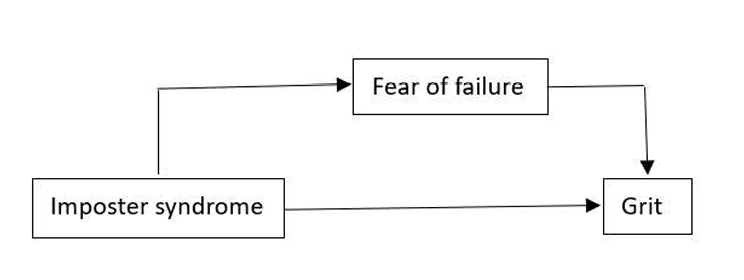
framework, so this study aims to understand
the impact of imposter syndrome on grit and the mediating role of fear of failure among
imposter syndrome and grit that will be helpful
i n fulfilling the theoretical knowledge
regarding imposter syndrome as well as
fostering the factors which promotes the
positivism and self confidence in the students
and planning of intervention plan for the
upliftment of mental wellbeing and self
confidence.
OBJECTIVES
1.To assess the nature and level of
association among imposter
syndrome, grit and fear of failure
among university students.
2.To know whether imposter syndrome
predict the grit among university
students.
3.To assess whether fear of failure
mediate the relationship between
imposter syndrome and grit.
METHODS
Design- Present study uses a correlational and
cross-sectional research design.
Working Research Framework:
Sample- The study’s sample consisted of 100
students aged between 18 to 25 years
(23.40±2.30) studying in constituent colleges
of Patna University Patna and Central
University of South Bihar Gaya town.
Participants were selected using stratified
systematic sampling. During selection of the
sample following exclusion and inclusion
criteria were taken under consideration to
make the population more homogenous.
Inclusion criteria
◾️ 19-24 years of age range
◾️ Who are pursuing degree and post degree program from constituent colleges in regular mode
◾️ Students only from Patna and Gaya town
◾️Students of either sex
◾️ Students who are able to comprehend and respond on the test items.
◾️ Exclusion criteria
◾️ Having any significant family or personal history and the illness
◾️ Who are pursuing degree and post degree program from constituent colleges in regular mode
◾️ Students only from Patna and Gaya town
◾️Students of either sex
◾️ Students who are able to comprehend and respond on the test items.
◾️ Exclusion criteria
◾️ Having any significant family or personal history and the illness
Tools used for data collection
Following measures were used in the
study,
1.
Imposter syndrome (Pauline Rose
Clance, 1985)- Clance Imposter
Phenomenon Scale (CIPS) developed by
Pauline Rose Clance in 1985, the CIPS is a 20
item self-report questionnaire designed to
measure imposter syndrome of individual
belonging to age range of 18 to 27. Items are
rated on 5-point Likert scale ranging from 1
(not at all true) to 5 (very true). The internal
consistency or reliability (Cronbach’s alpha
coefficient) for the scale is .93.
2.
Grit (Duckworth & Quinn, 2009)
(Short Grit Scale (Grit-S) developed by
Duckworth & Quinn in 2009, is 8-item self
report questionnaire among which 4 questions
are having reverse scoring designed to
measure grit with a range of ages, including
adults, college students, and even some
studies have included younger individuals.
Items are rated on 5-point Likert scale ranging
from 1 (very much like me) to 5 (not like me
at all). It has a high internal consistency, with
Cronbach’s alpha values typically ranging from
0.77 to 0.90.
3.
The Performance Failure Appraisal
Inventory (David E. Conroy, 2003)- The
Performance Failure Appraisal Inventory was
developed by David E. Conroy in 2003, is a
self-report questionnaire consist of 25 items
having five domains i.e., fear of experiencing shame and embarrassment, fear of devaluing
one’s self-estimate, fear of having a uncertain
future, fear of important others losing interest
and fear of upsetting important others. It is a
5 point Likert scale whereby “-2” indicates “Do
not believe at all”, “0” indicating “Believe 50%
of the time” and “+2” indicates “Believe 100%
of the time”. A higher rating of item indicates
higher general FOF level. The internal
consistency coefficient (Cronbach’s alpha)
ranges from .80 to .90.
PROCEDURE OF THE STUDY
The participants of the study were approached
according to inclusion and exclusion criteria.
Before collecting data from the participants
their inform consent were taken. Ethical
guidelines given by APA (2010) had been
followed in entire process of the study. After
the selection of the sample selected tools
were administered as per the prescribed
procedure in the concerned manual. The data
gathered was coded and then analysed using
SPSS software. For the analysis of the data
Pearson correlation, regression analysis and
mediation model using PROCESS macro
(SPSS) were used. Lastly the results were
discussed in great detail and the conclusion
were made based on that.
RESULTS
The aim of the study was to understand the
impact of imposter syndrome on grit and the
mediating role of fear of failure among
imposter syndrome and grit. Obtained results
are presented in the following subsections:
Table-1: Socio demographic
characteristics of the subjects.
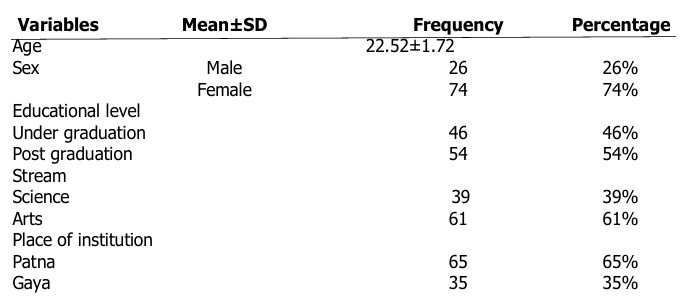
The table-1 shows participant’s
sociodemographic characteristics. The mean
age of the sample was 22.52 ranging from 20
to 24 (22.52±1.72). The majority of university
students were female who account for 74%
and male account for 26%. Among these
students 46% were undergraduates and 54%
were postgraduates including 39% from
science stream and 61% from arts stream.
65% of students were from Patna and 35%
were from Gaya districts.
Table-2 Association among all study
variables
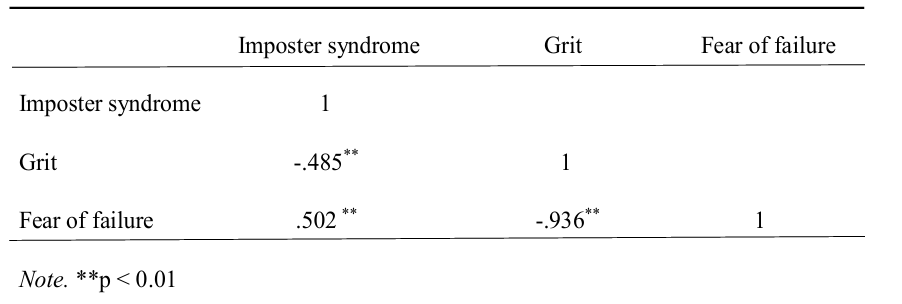
Table-2 show a strong negative correlation
to exist between imposter syndrome and grit
(r=-.485, p<.01), a strong positive correlation
to exist between imposter syndrome and fear
of failure (r=.502, p<.01) and a strong
negative correlation to exist between fear of
failure and grit (r=-.936, p<.01).Here, the
H1a, H1b and H1c are accepted that shows
there would be significant association between
imposter syndrome and grit, imposter
syndrome and fear of failure, and fear of
failure and grit among university students
respectively.
Table-3: Liner regression analysis with
imposter syndrome as predictor variable
and grit as criterion variable.
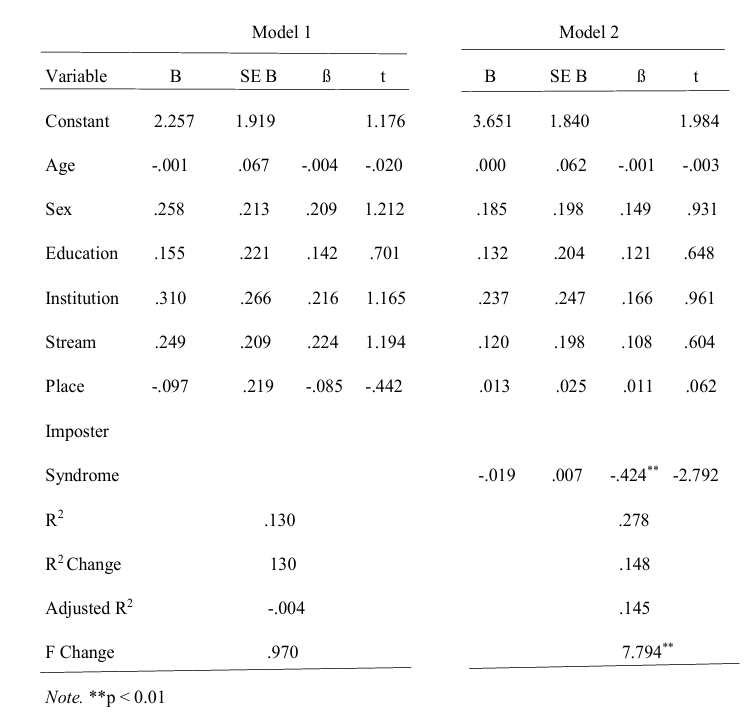
Table-3: Present the hierarchical linear
regression analysis using imposter syndrome
as predictor variable and grit as criterion
variable, after controlling the demographic
variable of the study.
In Model-1 the socio-demographic variable
age, sex, education, institution, stream and
place were controlled which shows it does not
significantly predict grit (R2=.130, F=.970)
showing 13% variance in grit that is not
significant. In Model-2 the imposter syndrome
is analysed as predictor variable and grit as
criterion variable controlling the socio
demographic variable, the result shows that
imposter syndrome significantly predict grit
(R2=.278, F=7.794, p<0.01). The negative
beta coefficient (ß=-.424) indicates that
higher imposter syndrome is associated with
lower level of grit. Imposter syndrome
contributes 14.8% variance in the grit. Here
the H2 is accepted that is Imposter syndrome
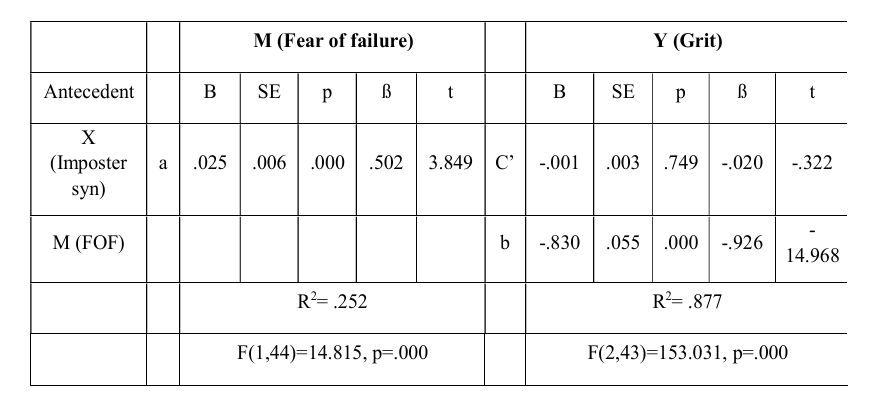
Table-4: Present the model summary of
mediation analysis using imposter syndrome
as predictor variable, grit as criterion variable
and fear of failure as mediator, showing full
mediation effect of fear of failure between the
imposter syndrome and grit. Imposter
syndrome has a significant impact (â=-.020,
t=-.322, p>.05). Here this is direct effect (c’)
which is not significant. The mediating
variable fear of failure was found to have
significant impact (â=-.926, t=-14.968,
p<.001). Here mediation is significant and it
is fully mediated because indirect effect is
significant, so, framed hypothesis H4 is
rejected i.e.. fear of failure is not significantly
mediated between imposter syndrome and grit
in university students.
DISCUSSION
The study was conducted to examine the
relationship among imposter syndrome, grit
and fear of failure, with fear of failure as a
mediating factor. Findings shows that there
is a significant negative correlation exist
between imposter syndrome and grit. Also,
the regression analysis shows that imposter
syndrome is significant predictor of grit and
the socio-demographic variables in were not
found to be significant, indicating that the
observed relationship between Imposter
syndrome and grit is independent of socio
demographic variable. This result support the
assumption that the individual with higher
level of imposter syndrome would be having
lower level of grit. This finding is also
consistent with previous evidence in the
literature supported by Charumitha A. et al.
(2024) and Macias-Moriarity et al. (2023), in
their study. At a conceptual level, imposter
syndrome and grit represent opposing
psychological orientations where imposter
syndrome is characterized by chronic self
doubt while grit is characterised by sustained
perseverance having confidence in long term
goal. This inherent contradiction can be theoretically explained using the Attribution
theory by Weiner, that states that motivation
is shaped by how individual describe their
success and failure (Attribution Theory (B.
Weiner) – InstructionalDesign.org, 2018).
Individual high in imposter syndrome attribute
success to external factors and their failure
to internal and stable factors which eventually
reduce motivation to persist and bring
demotivation towards long term goal
commitment that can be described as low grit
among the individual. Similarly, the
correlational analysis shows a highly
significant positive association between
i mposter syndrome and fear of failure
explaining the individual with higher level of
imposter syndrome will be having high fear
of failure. This finding is also consistent with
previous evidence in literature supported by
Noskeau et al. (2021), Nelson & Nelson (2019)
and others in their studies. This can be
explained by the Achievement Motivation
theory (Atkinson, 1957; Elliot & Church, 1997)
which states that fear of failure arises when
individuals associate failure with shame, loss
of self-worth, or social devaluation which is
very similar to having imposter syndrome,
therefore individual experience imposter
syndrome are more prone to experience fear
of failure. The correlational result analysis
also reveals a highly significant negative
association to exist between grit and fear of
failure explaining individual having higher level
of grit will be having lower level of fear of
failure. This finding is also consistent with
previous evidence in literature supported by
Birr et al. (2023). This can be explained by
Mindset theory (Dweck, 2006) which states
that individual growth mindset for learning
see mistakes as opportunities to learn and
improve. Grit is conceptually aligned with
growth mindset where abilities are viewed as
malleable and improved through effort
whereas fear of failure in contrast is strongly
linked to fixed mindset, therefore having a
negative association among them. The
mediation model shows that relationship
between imposter syndrome and grit is fully
mediated by fear of failure. Findings of the
present study reveals that imposter syndrome
negatively associated with grit, but this causal
relationship is explained by the fear of failure,
which makes a pathway for effect. There is
no direct effect of imposter syndrome on the
grit, but this link was developed only through
the fear of failure. As per Achievement
motivation theory, less motivated persistence
and self-doubt, which are the characteristics
of imposter syndrome, only affect the grit
level of the student when it enhances the level
of fear of failure in them.
Overall, the results showed a strongly
significant association between impostor
syndrome, grit, and fear of failure, with fear
of failure acting as a complete mediator
between imposter syndrome and grit.
CONCLUSION
This study gives an insight about the fear of
failure and finally affect the grit level of the
students , which become a major concern of
current generation students. It will also be
helpful to understand the fact that how
psychological experiences may connect with
distinct outcomes.
IMPLICATIONS
This study contributes to growing literature
by theoretically and empirically adding the
mediating role of fear of failure between
imposter syndrome and grit. No one previous
studies focus on this aspect, so that findings
of this study will be able to fulfil the
theoretical, empirical and geographical gap
related to conceptualization of imposter
syndrome. It wil also helpful in framing the
counselling and other psychological support
system for the students to enhance their
academic achievements. Psychoeducational
programs that normalize impostor experiences should be implemented in universities. By
helping students reframe maladaptive beliefs
about competence and failure, counselling
interventions based on cognitive-behavioral
approaches may lessen their fear of failing
and indirectly increase their grit. Universities
should adopt psychoeducational programs
that normalize impostor experiences.
Counselling interventions based on cognitive
behavioral approaches may help students
reframe maladaptive beliefs about
competence and failure, which may reduce
their fear of failing and indirectly boost their
grit.
LIMITATIONS
Limitation includes the regional homogeneity
of the sample, given the small sample size
(n=100) from a single state Bihar, the result
should be viewed as preliminary rather than
applicable to wider population. Wider range
of sample are needed for stronger conclusion
and generalization of application. Some other
variable can also be used to analysed as
mediator or moderator establishing the link
between imposter syndrome and grit.
Therefore, findings should be considered as
suggestive rather than conclusive.
Conflict of interest among authors: No
Ethical Clearance:
Prior to the onset of this study, ethical
clearance was obtained from Department
Research Degree Committee Department of
Psychological sciences Central University of
South Bihar (PSY/1305/03/06/25). All
pertinent ethical guidelines established by the
American Psychological Association (APA,
2002) were adhered to during the duration of
the research study.
REFERENCES
Admin, & Admin. (2024, March 20). The Power
of Grit: How to Help Students Achieve
success.
Inzpira.
https://
www.inzpira.com/the-power-of-grit
how-to-help-students- a c h i e v e
success/
Agrawal, S., Chandrasekaran, S., Yasmeen,
T., Kumar, S., & Kumar, S. (2025).
Prevalence of impostor syndrome
among undergraduate and
postgraduate medical students – A
cross- sectional study. Journal of
Indira Gandhi Institute of Medical
Sciences, 11(1), 75–79.
h t t p s : / / d o i . o r g / 1 0 . 4 1 03 /
jigims.jigims_55_24
Anand, C., Shree, K. A. P., Kavishree, B.,
Vidhubala, S. S., Sowmiya, C., &
Yazhini, S. (2024).
The impact of
i mpostor syndrome on grit.
International Journal of Indian
Psychology,
12(4), Article 156.
https://doi.org/10.25215/1204.156
Anand, C., Shree, K. A. P., Kavishree, B.,
Vidhubala, S. S., Sowmiya, C., &
Yazhini, S. (2024).
The impact of
i mpostor syndrome on grit.
International Journal of Indian
Psychology,
12(4), Article 156.
https://doi.org/10.25215/1204.156
Attribution Theory (B. Weiner)
InstructionalDesign.org. (2018,
November
30).
InstructionalDesign.org.https://
www.instructionaldesign.org/
theories/attribution
theory
Bangar, H., Sekhon, M. K., & Narula, A. (2024).
A Study on Fear of Failure an d
Academic
Procrastination among
College Students. International
Journal of Interdisciplinary
Approaches in Psychology, 2(12).
h t t p s :/ / doi. o rg/10.61113/
ijiap.v2i12.622
Birr, C., Hernández-Mendo, A., Monteiro, D.,
Brandão, R., & Rosado, A. (2023).
Relations
between empowering
and disempowering motivational climate with burnout, fear of failure
and grit. International Journal of
Sports Science & Coaching, 19(3),
1164 1174.
h t t ps://doi.org/
10.1177/17479541231191086
Elliot, A. J., & Church, M. A. (1997). A
hierarchical model of approach and
avoidance
a c h i e v e m e n t
motivation. Journal of Personality and
Social Psychology, 72(1), 218–232.
https://doi.org/10.1037/0022
3514.72.1.218
Holden, C. L., Wright, LindsayE., Herring, A.
M., & Sims, PatL. (n.d.). Imposter
Syndrome
Among First-and
Continuing-Generation College
Students: The Roles of Perfectionism
and Stress. Journal of College Studen
t Retention: Research,Theory &
Practice, 25(4).
h t t p s : / /
doi.org/10.1177/15210251211019379
Koshy, H. A., Wilson, P. P., Abraham, K. R.,
Sebastian, S. T., Jacob, F. G., Nair, N.
B., & John,
J. M. (2022). Imposter
Phenomenon, Perfectionism and Fear
of Failure among
E m e r g i n g
Adults. International Journal of
Research Publication and Reviews,
03(12),2763–2766. https://doi.org/
10.55248/gengpi.2022.31293
Krista L. Nelson, Kennedy Nelson (2019).
Majoring in STEM: How the factors of
fear of f
ailure,
i mpostor
phenomenon, and self-efficacy impact
decision-making. National
Social
Science Journal, 52(1):76 https://
www.researchgate.net/profile/Jet
Macias-Moriarity, L. Z., Sinclair, S. M., Walker,
D., & Purnell, M. (2023). Impostor
phenomenon and grit as predictors of
job satisfaction in female pharmacy
faculty. Pharmaceutical Research,
40(10), 2271–2280. https://doi.org/
10.1007/s11095-023 03518-9
Noskeau, R., Santos, A., & Wang, W. (2021).
Connecting the dots between mindset
and
i mpostor phenomenon, via
fear of failure and goal orientation, in
working adults.
Frontiers in
Psychology, 12. https://doi.org/
10.3389/fpsyg.2021.588438
Siraj, R. A., Aldhahir, A. M., Alzahrani, Y. R.,
Alqarni, A. A., Alanazi, T. M., Alruwaili,
A.,
Algarni, S. S., Alghamdi, A. S.,
Alahmari, M. A., Baogbah, A. A.,
AlQahtani, A. S.,
Alasimi, A. H.,
Alsolami, S. S., Alqarni, M. A.,
Alahmadi, F. H., & Alshammari, G. S.
(2024). The impact of imposter
syndrome on self-esteem and
intention to quit among
respiratory therapy (RT) students in
Saudi Arabia. SAGE Open Medicine,
12,
20503121241260149. https://
doi.org/10.1177/20503121241260149
Conflict of interest: None
Role of funding source: None
