

Indian Journal of Health Social Work
(UGC CARE List Journal)
LOCUS OF CONTROL AND PSYCHOLOGICAL ISSUES AMONG ARMY
PERSONNEL
Nandha Kumara Pujam. S.
Associate Professor of Clinical Psychology, Rashtriya Raksha University (An
Institution of National Importance), Shivamogga Campus, Karnataka.
Correspondence: Nandha Kumara Pujam. S., e-mail: nandhakumara2008@gmail.com
ABSTRACT
Background: Besides national security, Indian Army personnel are involved in other pivotal
duties such as border security, internal security and disaster management. Across the world,
army personnel face arduous and complicated responsibilities, which creates a disposition to
develop into various psychiatric issues such as depression, anxiety disorder, substance use and
suicide. Additionally, external locus of control was found to have better adaptability among soldiers
who are deployed in low-intensity conflict and other areas. Therefore, to have an inclusive
understanding. Aim: To examine the role of locus of control in mental health issues among Army
personnel. Methods: The present study is a cross-sectional design conducted at Rashtriya Raksha
University, Gujarat, on 50 Army personnel, who were administered the DASS-21 and Rotter’s
Locus of Control Scale. Results: The present study observed that Army personnel suffer from
mild levels of depression, anxiety and stress. The current research also found that on locus of
control, 42 (84.0%) of army personnel had internal locus of control, and 8 (16.0%) had external
locus of control. Conclusion: The present research on Indian Army personnel finds that, despite
having an internal locus of control, they suffer from depression, anxiety, and stress. Apart from
counselling, they should provide mental health literacy to educate about mental illness, and
regular capacity-building training to enhance coping skills is recommended.
Keywords: Depression; anxiety; stress; Army Personnel; DASS-21.
Submitted: 05.07.2025 Revised: 12.08.2025 Accepted: 03.09.2025 Published: 28.01.2026
How to cite this article: Pujam, N. K. S. (2025). Locus of control and psychological issues
among Army personnel. Indian Journal of Health Social Work, 7(2), 71-74.
INTRODUCTION
Besides national security, Indian Army personnel are involved in other pivotal duties such as border security, internal security and disaster management (Verma et al., 2013). Across the world, army personnel face arduous and complicated responsibilities, which creates a disposition to develop into various psychiatric issues such as depression, anxiety disorder, substance use and suicide (Argyropoulos et al., 2005). In a study conducted at Hyderabad on 520 Central Industrial Security Force (CISF) personnel, it was reported that most of the security personnel suffer from generalised anxiety and major depressive disorders (Rao et al., 2008). Additionally, occupational stress is also reported among Indian Army personnel (Pradhan et al., 2020). Moreover, it was observed that locus of control is associated with post-traumatic stress disorder (Solomon, Mikulincer, & Avitzur, 1988). Julian B. Rotter used the term “locus of control” to denote the degree to which individuals believe they can gain control of their lives, despite external forces (Rotter, 1966). Enigmatically, external locus of control was found to have better adaptability among soldiers who are deployed in low-intensity conflict and other areas (Chaudhury, Goel and Singh, 2006). Conversely, in another study it was observed that internal locus of control was negatively correlated with post-traumatic stress symptoms (Reddy et al., 2022). There is a dearth of mental health training for Army personnel, and only a few studies are reported in the Indian context on psychiatric issues and locus of control. Therefore, to have an inclusive understanding, the present study aims to examine the role of locus of control i n mental health issues among Army personnel.
Besides national security, Indian Army personnel are involved in other pivotal duties such as border security, internal security and disaster management (Verma et al., 2013). Across the world, army personnel face arduous and complicated responsibilities, which creates a disposition to develop into various psychiatric issues such as depression, anxiety disorder, substance use and suicide (Argyropoulos et al., 2005). In a study conducted at Hyderabad on 520 Central Industrial Security Force (CISF) personnel, it was reported that most of the security personnel suffer from generalised anxiety and major depressive disorders (Rao et al., 2008). Additionally, occupational stress is also reported among Indian Army personnel (Pradhan et al., 2020). Moreover, it was observed that locus of control is associated with post-traumatic stress disorder (Solomon, Mikulincer, & Avitzur, 1988). Julian B. Rotter used the term “locus of control” to denote the degree to which individuals believe they can gain control of their lives, despite external forces (Rotter, 1966). Enigmatically, external locus of control was found to have better adaptability among soldiers who are deployed in low-intensity conflict and other areas (Chaudhury, Goel and Singh, 2006). Conversely, in another study it was observed that internal locus of control was negatively correlated with post-traumatic stress symptoms (Reddy et al., 2022). There is a dearth of mental health training for Army personnel, and only a few studies are reported in the Indian context on psychiatric issues and locus of control. Therefore, to have an inclusive understanding, the present study aims to examine the role of locus of control i n mental health issues among Army personnel.
METHODOLOGY
To know the frequency of depression, anxiety and stress among Army personnel. To know the locus of control among Army personnel. Venue: Rashtriya Raksha University, Lavad, Gujarat. Study design: cross sectional design. Sample and sampling: 50 Army personnel were selected in the study using purposive sampling method.
To know the frequency of depression, anxiety and stress among Army personnel. To know the locus of control among Army personnel. Venue: Rashtriya Raksha University, Lavad, Gujarat. Study design: cross sectional design. Sample and sampling: 50 Army personnel were selected in the study using purposive sampling method.
Tools used
Socio Demographic Data Sheet
The current study used a socio- demographic
data sheet to collect the demographic details,
which include age, gender, education, and
marital status.
Depression, Anxiety and Stress Scale
(DASS 21) Lovibond & Lovibond (1995) developed this 21 item self-report questionnaire. Each of the 7 items of this scale represents the constructs of depression, anxiety, and stress. The scores range between 0 and 3, with 0 representing never, 1 indicating sometimes, 2 indicating often, and 3 indicating almost always (Lovibond & Lovibond 1995).
(DASS 21) Lovibond & Lovibond (1995) developed this 21 item self-report questionnaire. Each of the 7 items of this scale represents the constructs of depression, anxiety, and stress. The scores range between 0 and 3, with 0 representing never, 1 indicating sometimes, 2 indicating often, and 3 indicating almost always (Lovibond & Lovibond 1995).
Locus of control scale (Rotter, 1966)
It is a 29-item scale that assesses whether individuals have control over the events in their lives or outside forces such as luck or chance factors control their lives. Higher scores indicate external locus of control (Rotter, 1966).
It is a 29-item scale that assesses whether individuals have control over the events in their lives or outside forces such as luck or chance factors control their lives. Higher scores indicate external locus of control (Rotter, 1966).
PROCEDURE
Primarily, the permission from the army chief was taken at Ahmedabad Cantonment. After explaining the objective of the research, consent was taken from each army person. Subsequently, a socio-demographic data sheet, the DASS-21 (Lovibond & Lovibond, 1995), and the Rotter locus of control scale (Rotter, 1966) were administered to all 50 Army personnel.
Primarily, the permission from the army chief was taken at Ahmedabad Cantonment. After explaining the objective of the research, consent was taken from each army person. Subsequently, a socio-demographic data sheet, the DASS-21 (Lovibond & Lovibond, 1995), and the Rotter locus of control scale (Rotter, 1966) were administered to all 50 Army personnel.
STATISTICAL ANALYSIS
The Statistical Package for the Social Sciences (SPSS) 16.0 version was used for descriptive statistics and socio-demographic data. Additionally, to understand the frequency of depression, anxiety, stress and locus of control, descriptive statistics were analysed. (SPSS Inc. 2007).
The Statistical Package for the Social Sciences (SPSS) 16.0 version was used for descriptive statistics and socio-demographic data. Additionally, to understand the frequency of depression, anxiety, stress and locus of control, descriptive statistics were analysed. (SPSS Inc. 2007).
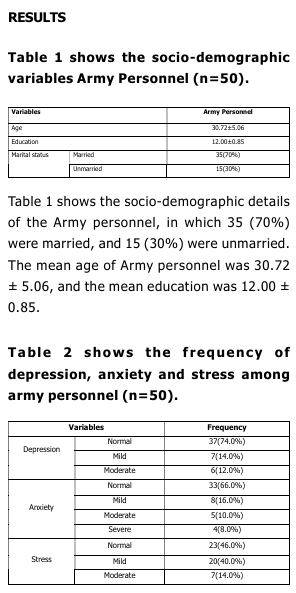
Table 2 shows the frequency of depression,
anxiety and stress among army personnel
using descriptive statistics. It shows that 7
(14.0%) of Army personnel were suffering
from mild depression, and 6 (12.0%) of them
were suffering from moderate depression.
Likewise, 8 (16.0%), 5 (10.0%), and 4 (8.0%)
Army personnel suffer from mild, moderate,
and severe anxiety, respectively. Additionally,
20 (40.0%) and 7 (14.0%) Army personnel
suffer from mild and moderate stress,
respectively.
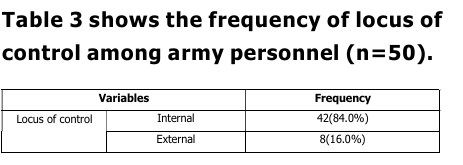
Table 3 shows the frequency of locus of
control among army personnel, of which 42
(84.0%) had internal locus of control and
8(16.0%) were having external locus of
control.
DISCUSSION
The present study observed mild depression in 7 (14.0%) of Army personnel, and 6 (12.0%) were suffering from moderate depression. This finding is in accord with the earlier research conducted on 222 Greek Army personnel, which reported that 82 personnel were identified as having anxiety disorder, depressive episode and alcohol abuse (Argyropoulos et al., 2005). Additionally, the present study found that 8 (16.0%), 5 (10.0%), and 4 (8.0%) of Army personnel were suffering from mild, moderate, and severe anxiety, respectively. This finding is in support of the study conducted on 520 Central Industrial Security Force (CISF) personnel at Hyderabad, which reported that most of them suffer from generalised anxiety disorder and major depressive disorders (Rao et al., 2008). Furthermore, 20 (40.0%) and 7 (14.0%) Army personnel suffer from mild and moderate stress, respectively. This finding is in line with the previous research conducted on 150 Indian Army personnel, which reported a high level of occupational stress among Army officers (Pradhan et al., 2020). The current research found that on locus of control, 42 (84.0%) of army personnel had internal locus of control, and 8 (16.0%) had external locus of control. This result is in accord with a cross-sectional survey of 785 U.S. soldiers that observed that internal locus of control was negatively correlated with post-traumatic stress symptoms (Reddy et al., 2022). However, a study on 262 Israeli soldiers stated that locus of control is associated with post-traumatic stress disorder (Solomon, Mikulincer, & Avitzur, 1988). Conversely, in another study it was reported that the soldiers who are deployed in low-intensity conflict and other areas had an external locus of control (Chaudhury, Goel and Singh, 2006).
The present study observed mild depression in 7 (14.0%) of Army personnel, and 6 (12.0%) were suffering from moderate depression. This finding is in accord with the earlier research conducted on 222 Greek Army personnel, which reported that 82 personnel were identified as having anxiety disorder, depressive episode and alcohol abuse (Argyropoulos et al., 2005). Additionally, the present study found that 8 (16.0%), 5 (10.0%), and 4 (8.0%) of Army personnel were suffering from mild, moderate, and severe anxiety, respectively. This finding is in support of the study conducted on 520 Central Industrial Security Force (CISF) personnel at Hyderabad, which reported that most of them suffer from generalised anxiety disorder and major depressive disorders (Rao et al., 2008). Furthermore, 20 (40.0%) and 7 (14.0%) Army personnel suffer from mild and moderate stress, respectively. This finding is in line with the previous research conducted on 150 Indian Army personnel, which reported a high level of occupational stress among Army officers (Pradhan et al., 2020). The current research found that on locus of control, 42 (84.0%) of army personnel had internal locus of control, and 8 (16.0%) had external locus of control. This result is in accord with a cross-sectional survey of 785 U.S. soldiers that observed that internal locus of control was negatively correlated with post-traumatic stress symptoms (Reddy et al., 2022). However, a study on 262 Israeli soldiers stated that locus of control is associated with post-traumatic stress disorder (Solomon, Mikulincer, & Avitzur, 1988). Conversely, in another study it was reported that the soldiers who are deployed in low-intensity conflict and other areas had an external locus of control (Chaudhury, Goel and Singh, 2006).
CONCLUSIONS
The present research on Indian Army personnel finds that, despite having an internal locus of control, they suffer from depression, anxiety, and stress. Apart from counselling, they should provide mental health literacy to educate about mental illness, and regular capacity-building training to enhance coping skills is recommended.
The present research on Indian Army personnel finds that, despite having an internal locus of control, they suffer from depression, anxiety, and stress. Apart from counselling, they should provide mental health literacy to educate about mental illness, and regular capacity-building training to enhance coping skills is recommended.
LIMITATIONS
The present study didn’t measure the coping style and other psychopathology such as suicide, which should have given a comprehensive picture of their psychological i ssue. Future studies should focus on longitudinal and intervention-based design. Acknowledgments and disclosures The author reports no competing interests.
The present study didn’t measure the coping style and other psychopathology such as suicide, which should have given a comprehensive picture of their psychological i ssue. Future studies should focus on longitudinal and intervention-based design. Acknowledgments and disclosures The author reports no competing interests.
REFERENCES
Argyropoulos, I.T., Samakouri, M.A., Balascas, D.K., Dalapascha, M., Pallas, D.P., Livaditis, M.D. (2005). Mental health problems of Army personnel seen in medical outpatient clinics in Greece, International Journal of Psychiatry in Medicine, 35, 3, 225-239. Chaudhury, S., Goel, D.S., and Singh, H. (2006). Psychological effects of low intensity conflict (LIC) operations. Indian Journal of Psychiatry, 48, 223–231. Lovibond, S. H., & Lovibond, P. F. (1995). Manual for the Depression Anxiety & Stress Scales. (2nd Ed.) Sydney: Psychology Foundation. Pradhan, J., Pathak, V.N., Bansal, D., Chaudhary, A. (2020). Occupational Stress, Psychological Well-being and Quality of Life among Indian Army Personnel. Defence life science journal, 5,3, 211-216. Rao, G. P., Moinuddin, K., Sai, P.G., Sarma, E., Sarma, A., Rao, P.S. (2008). A study of stress and psychiatric morbidity in the Central Industrial Security Force. Indian Journal of Psychological Medicine, 30, 1, 39–47. Reddy, M.K., Nugent, K., Riviere, L.A. (2022). Problem-focused coping moderates the i mpact of locus of control on posttraumatic stress symptoms among U.S. soldiers. Psychiatry Research Communications, 2, 4. Rotter, J. B. (1966). Generalized expectancies for internal versus external control of r e i nforcement. Psychological Monographs: General and Applied, 80(1), 1–28. Solomon, Z., Mikulincer, M., Avitzur, E. (1988). Coping, Locus of Control, Social Support, and Combat-Related Posttraumatic Stress Disorder: A Prospective Study, Journal of Personality and Social Psychology, 55, 2, 279-285. SPSS Inc. Released 2007. SPSS for Windows, Version 16.0. Chicago, SPSS Inc. Verma, R., Mina, S., and Deshpande, S.N. (2013). An analysis of paramilitary referrals to psychiatric services at a tertiary care center. Industrial Psychiatry Journal, 22, 1, 54-59.
Argyropoulos, I.T., Samakouri, M.A., Balascas, D.K., Dalapascha, M., Pallas, D.P., Livaditis, M.D. (2005). Mental health problems of Army personnel seen in medical outpatient clinics in Greece, International Journal of Psychiatry in Medicine, 35, 3, 225-239. Chaudhury, S., Goel, D.S., and Singh, H. (2006). Psychological effects of low intensity conflict (LIC) operations. Indian Journal of Psychiatry, 48, 223–231. Lovibond, S. H., & Lovibond, P. F. (1995). Manual for the Depression Anxiety & Stress Scales. (2nd Ed.) Sydney: Psychology Foundation. Pradhan, J., Pathak, V.N., Bansal, D., Chaudhary, A. (2020). Occupational Stress, Psychological Well-being and Quality of Life among Indian Army Personnel. Defence life science journal, 5,3, 211-216. Rao, G. P., Moinuddin, K., Sai, P.G., Sarma, E., Sarma, A., Rao, P.S. (2008). A study of stress and psychiatric morbidity in the Central Industrial Security Force. Indian Journal of Psychological Medicine, 30, 1, 39–47. Reddy, M.K., Nugent, K., Riviere, L.A. (2022). Problem-focused coping moderates the i mpact of locus of control on posttraumatic stress symptoms among U.S. soldiers. Psychiatry Research Communications, 2, 4. Rotter, J. B. (1966). Generalized expectancies for internal versus external control of r e i nforcement. Psychological Monographs: General and Applied, 80(1), 1–28. Solomon, Z., Mikulincer, M., Avitzur, E. (1988). Coping, Locus of Control, Social Support, and Combat-Related Posttraumatic Stress Disorder: A Prospective Study, Journal of Personality and Social Psychology, 55, 2, 279-285. SPSS Inc. Released 2007. SPSS for Windows, Version 16.0. Chicago, SPSS Inc. Verma, R., Mina, S., and Deshpande, S.N. (2013). An analysis of paramilitary referrals to psychiatric services at a tertiary care center. Industrial Psychiatry Journal, 22, 1, 54-59.
Conflict of interest: None
Role of funding source: None
