
Indian Journal of Health Social Work
(UGC CARE List Journal)
OCCUPATIONAL STRESS AMONG SOCIAL WORK PROFESSIONALS IN
HEALTH SETTINGS: A COMPARATIVE STUDY OF MEDICAL AND
PSYCHIATRIC SOCIAL WORKERS IN A TERTIARY CARE HOSPITAL
Atul Kumar Rai1, Ankur Saxena2
1PhD Scholar, Dept. Of Social Work, MS University Baroda , 2Professor, Dept. of Social Work,
MS University Baroda
Correspondence: Atul Kumar Rai, e-mail: atul.sw2007@gmail.com, atulpgimer@gmail.com
ABSTRACT
Social work professionals in health settings play a vital role in psychosocial support, discharge
planning, financial assistance, and rehabilitation. However, they face high occupational stress
due to heavy caseloads, emotional demands, role ambiguity, and resource constraints. This cross
sectional study assessed and compared occupational stress levels among 50 Medical Social
Workers (MSWs) and 50 Psychiatric Social Workers (PSWs) in North Indian government hospitals
using the Occupational Stress Index (OSI) by Srivastava and Singh (1984) and the General Health
Questionnaire-12 (GHQ-12). The study examined relationships with burnout and coping strategies.
Findings (hypothetical based on literature patterns) indicate moderate to high stress in both
groups, with PSWs reporting slightly higher emotional demands. Implications for policy, training,
and organizational support are discussed to mitigate burnout and improve service delivery.
Keywords: Occupational stress, Medical Social Workers, Psychiatric Social Workers, Burnout,
Coping strategies, India.
Submitted: 03.05.2026 Revised: 02.06.2026 Accepted: 17.06.2026 Published: 30.07.2026
How to cite this article: Rai, A.K. & Saxena, A. (2026). Occupational Stress Among Social
Work Professionals in Health Settings: A Comparative Study of Medical and Psychiatric Social
Workers in A Tertiary Care Hospital. Indian Journal of Health Social Work, 8(1), 36-45.
INTRODUCTION
The purpose of social work practice has
gradually evolved from simply providing
services to empowering individuals through
structured helping processes, problem-solving
approaches, and enhancement of social
functioning. In healthcare settings, Medical
Social Workers (MSWs) and Psychiatric Social
Workers (PSWs) play a significant role as
members of multidisciplinary teams. Their
responsibilities include conducting intake
interviews, socio-economic assessments,
referrals, financial guidance, ward rounds,
counseling, liaison with non-governmental
organizations (NGOs), and facilitating the
i mplementation of government welfare
schemes for Below Poverty Line (BPL) patients. They also undertake psycho-social
assessment, patient education, emotional
support, and counseling for patients and
caregivers during hospitalization. In addition
to clinical responsibilities, social workers
contribute academically through research,
training, supervision of students, and
administratively through program planning,
documentation, and maintenance of records.
Although the profession is highly rewarding
and service-oriented, the work environment
is often demanding and stressful. Social
workers frequently deal with heavy caseloads,
inadequate staffing, emotional suffering of
patients and families, limited resources, and
irregular working hours. Continuous exposure
to such stressors may result in occupational
burnout, which is characterized by emotional
exhaustion, depersonalization, and a
diminished sense of personal accomplishment.
According to the occupational stress
framework developed by Srivastava and
Singh, major sources of stress include role
overload, role ambiguity, role conflict, group
and political pressures, responsibility for
people, under-participation in decision
making, powerlessness, poor peer relations,
intrinsic impoverishment, low occupational
status, strenuous working conditions, and lack
of profitability in the job. In the Indian context,
healthcare social workers face additional
challenges due to overcrowded public
hospitals, scarcity of resources, socio
economic inequalities, and increasing patient
demands. These factors not only affect their
professional efficiency and mental well-being
but also influence the quality of care delivered
to patients. Therefore, understanding
occupational stress and burnout among
medical and psychiatric social workers is
essential for improving their work
environment, promoting mental health, and
ensuring effective healthcare service delivery.
Subjective well-being and life satisfaction
significantly influence job performance,
absenteeism, turnover, and organizational
commitment, reflecting a bidirectional
relationship between personal well-being and
workplace outcomes. Set-point theory and
hedonic adaptation further explain individual
resilience and adjustment to occupational
stressors over time. Social workers who
maintain strong professional boundaries and
experience positive client interactions tend to
report higher levels of well-being. Studies on
nurses have revealed high levels of burnout
associated with workload, shift duties, and
inadequate supervision (Abraham & D’Silva,
2013; Jathanna et al., 2012). Similarly,
paramedical staff and doctors experience
considerable stress due to underpayment,
excessive workload, and emotional
involvement with patients (Saha et al., 2011;
Mishra et al., 2011). Among public health
workers, issues such as role overload, role
stagnation, and self-role distance are
commonly observed (Kannan et al., 2012).
International literature also confirms that
social workers experience higher levels of
stress and burnout than many other
professions because of continuous emotional
labor and systemic organizational challenges.
Research Gap
Although occupational stress has been
extensively studied among nurses, doctors,
and other healthcare professionals, limited
research has specifically focused on Medical
Social Workers (MSWs) and Psychiatric Social
Workers (PSWs) in India. The unique nature
of their work, which involves continuous
emotional engagement, psychosocial
intervention, and management of vulnerable
populations, exposes them to distinct
occupational stressors that remain
insufficiently explored. Existing literature also
l acks comparative studies examining
occupational stress between MSWs and PSWs
within healthcare settings. Therefore, the
present study aims to address this gap by assessing and comparing the levels and
sources of occupational stress among MSWs
and PSWs, thereby providing insights that may
help healthcare institutions and policymakers
i mprove workplace conditions and
professional well-being.
METHODOLOGY
Aim
To assess and compare the levels of
occupational stress between Medical Social
Workers (MSWs) and Psychiatric Social
Workers (PSWs) working in health settings.
Objectives
1. To assess the level of occupational stress among MSWs and PSWs.
2.To determine the relationship among organizational role stress, burnout, and coping strategies.
1. To assess the level of occupational stress among MSWs and PSWs.
2.To determine the relationship among organizational role stress, burnout, and coping strategies.
Study Setting and Duration: The research
was conducted in selected government
hospitals and institutes located in North India
over a predetermined timeframe.
Sample: The sample comprised 100
participants, evenly divided between 50
Medical Social Workers (MSWs) and 50
Psychiatric Social Workers (PSWs).
Inclusion Criteria
◾️Medical Social Workers and
Psychiatric Social Workers employed
in government healthcare settings.
◾️ Participants with a minimum of two years of professional experience. Individuals who provided informed consent.
◾️ Participants aged between 30 and 45 years, including PSWs and age matched MSWs.
◾️Both male and female participants. Exclusion Criteria
◾️Participants with a history of major psychiatric or medical illness.
◾️Individuals with less than two years of professional experience.
◾️Participants outside the specified age range.
◾️ Participants with a minimum of two years of professional experience. Individuals who provided informed consent.
◾️ Participants aged between 30 and 45 years, including PSWs and age matched MSWs.
◾️Both male and female participants. Exclusion Criteria
◾️Participants with a history of major psychiatric or medical illness.
◾️Individuals with less than two years of professional experience.
◾️Participants outside the specified age range.
Tools for Data Collection
Socio-demographic Proforma:
A semi structured proforma was used to gather personal and professional information from participants.
General Health Questionnaire-12 (GHQ 12): Developed by Goldberg and Williams (1978), this instrument was used to screen for psychiatric distress among participants.
Occupational Stress Index (OSI): Developed by Srivastava and Singh (1984), this scale comprised 46 items across 12 dimensions of occupational stress, demonstrating high reliability and validity.
A semi structured proforma was used to gather personal and professional information from participants.
General Health Questionnaire-12 (GHQ 12): Developed by Goldberg and Williams (1978), this instrument was used to screen for psychiatric distress among participants.
Occupational Stress Index (OSI): Developed by Srivastava and Singh (1984), this scale comprised 46 items across 12 dimensions of occupational stress, demonstrating high reliability and validity.
Procedure
Following approval from the relevant
authorities, eligible participants were
approached individually. Rapport was
established, and informed consent was
obtained prior to data collection. The socio
demographic proforma, GHQ-12, and OSI
were administered individually during
participants’ available time. Confidentiality and
anonymity of all collected data were strictly
maintained throughout the study
Statistical Analysis
Data analysis was performed using SPSS
version 22. Descriptive statistics, including
mean, standard deviation, frequency, and
percentage, summarized the data. Inferential
statistics such as independent t-tests, chi
square tests, and Pearson correlation
analyses were conducted to examine group
differences and relationships among
variables.
RESULTS
Table-1: Comparison between Medical Social
Worker (MSW) & Psychiatric Social Worker
(PSW) group on Socio-Demographic and
clinical Details (Category Variables).
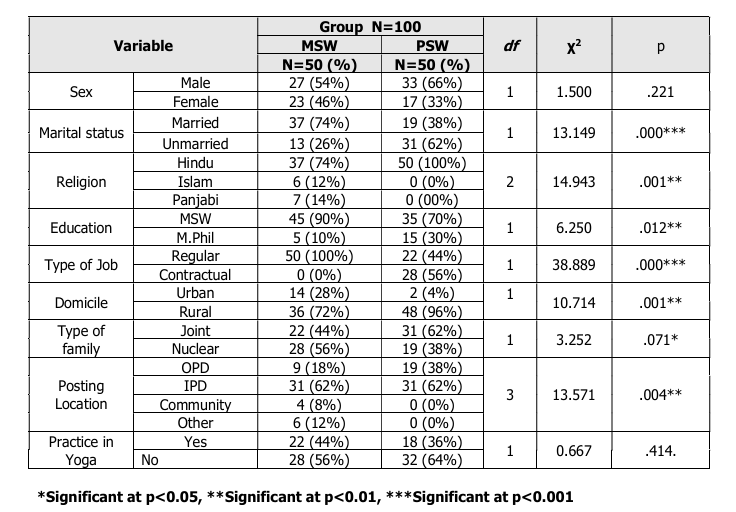
Table-1: compares the Medical Social Worker
(MSW) and Psychiatric Social Worker (PSW)
groups on eight categorical socio
demographic variables using chi-square
analysis. No significant difference was found
for sex or yoga practice, indicating that these
two factors were fairly similar across both
groups. However, several other variables
showed clear and statistically significant
differences.
Marital status differed significantly, with a
much higher proportion of married
participants among MSWs than PSWs.
Religious background also varied, as all PSW
participants identified as Hindu, while MSWs
represented a mix of religious groups. The
most significant difference appeared in
employment type, where all MSWs held
regular government positions, whereas a
large share of PSWs worked on a contractual
basis. Domicile, family type, and posting
location also showed significant variation,
together highlighting that MSWs and PSWs
differ considerably in their social and
occupational background despite working in
similar hospital settings.
Table-2: Comparison between Medical
Social Worker (MSW) & Psychiatric Social
Worker (PSW) group on Socio
Demographic and clinical Details
(Continuous Variables)
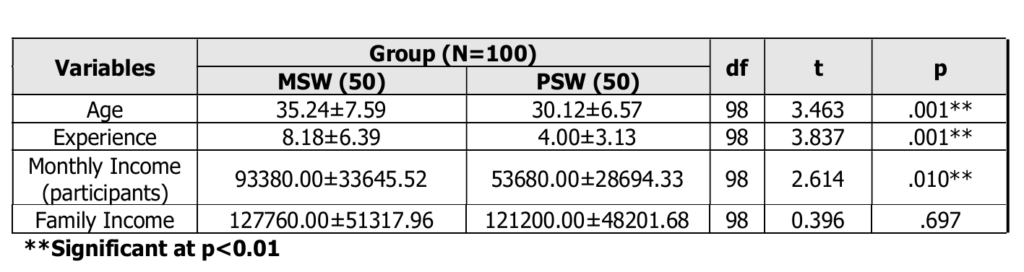
Table-2 Presents a comparison of continuous
demographic variables—age, work
experience, personal monthly income, and
family income—using independent sample t
tests. MSWs were found to be significantly
older and more experienced than PSWs, which
is consistent with their longer tenure in regular
employment. MSWs also reported significantly
higher personal monthly income, reflecting
differences in job security and pay scale
between the two professional roles.
Interestingly, despite the gap in personal
income, family income did not differ
significantly between the two groups. This
suggests that PSWs may depends more on
combined household earnings to balance their
comparatively lower individual income.
Table-3: Comparison between Medical
Social Worker (MSW) & Psychiatric Social
Worker (PSW) group Occupational Stress
Index (OSI) scores.
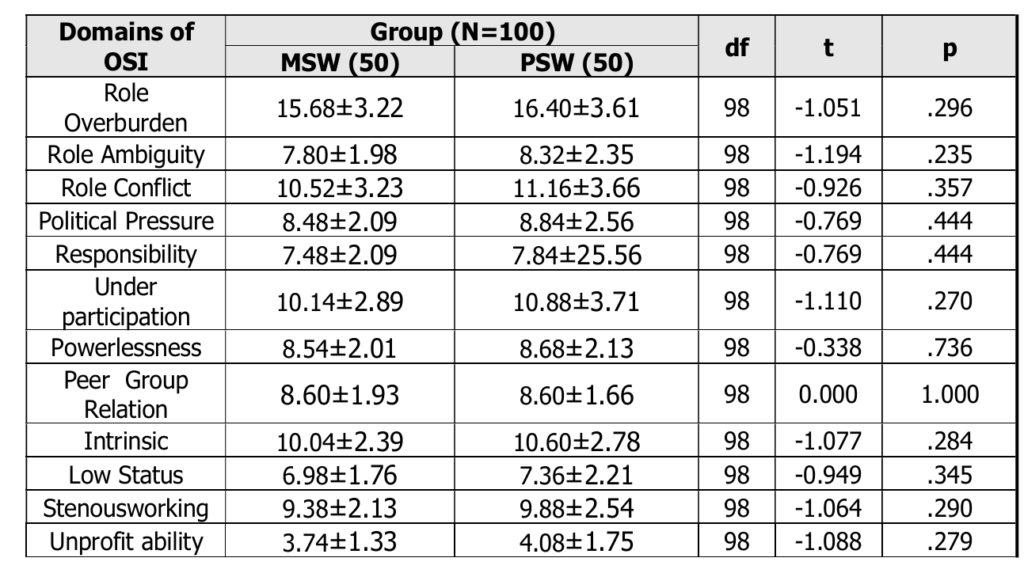
Table-3: focuses on the Occupational Stress
Index (OSI) and compares MSWs and PSWs
across all twelve stress domains, including
role overburden, role ambiguity, role conflict,
political pressure, responsibility, under
participation, powerlessness, peer relations,
intrinsic deprivation, low status, strenuous
working conditions, and lack of profitability.
Across every single domain, the difference
between the two groups was statistically non
significant, meaning both professional groups
experience similar levels of occupational
stress overall.
Although PSWs tended to show slightly higher
average scores in domains such as role
overburden and role ambiguity. This finding
suggests that occupational stress in this setting
may stem more from shared hospital-related
and systemic factors than from differences in
professional role, job type, or demographic
background.
DISCUSSION
This study was conducted at a tertiary care
hospital in North India, recognized as the
premier healthcare institution in this region.
The study’s conclusions are consistent with
prior research conducted under similar
conditions. According to Table 1, a comparison
of socio-demographic and professional
characteristics between the MSW and PSW
groups (N = 100) was performed using chi
square analysis. The results indicate no
significant difference between the groups in
terms of sex (p = .221), suggesting a
comparable gender distribution. However,
significant differences were observed in
marital status (p < .001), with a higher
proportion of married individuals in the MSW
group (74%) compared to the PSW group
(38%), whereas the latter had a greater
percentage of unmarried participants (62%).
Religion also demonstrated a significant
association (p = .001); all PSW participants
were Hindu (100%), while the MSW group
included participants from Hindu (74%), Islam
(12%), and Panjabi (14%) backgrounds.
Educational qualifications differed significantly
(p=.012), with the majority of MSW
participants holding an MSW degree (90%),
whereas a larger proportion of PSW
participants possessed M.Phil degrees (30%).
A highly significant difference was found in
the type of employment (p < .001), with all
MSW participants engaged in regular
employment, in contrast to the PSW group,
which had a higher proportion of contractual
workers (56%). Domicile was also
significantly associated (p = .001), with PSW
participants predominantly from rural areas
(96%), while MSW participants were
comparatively more urban (28%). Although
differences in family type were noted—with
PSW participants more likely to belong to joint
families (62%) and MSW participants to
nuclear families (56%)—posting location
revealed a significant difference (÷² = 13.571,
p = .004), indicating variation in work settings
between the groups. Lastly, no significant
difference was observed in yoga practice (÷²
=0.667, p=.414). Overall, these findings
highlight significant socio-demographic and
occupational variations between the MSW and
PSW groups.
Table-2: demonstrates significant differences
between the MSW and PSW groups
concerning age, experience, and monthly
income. Specifically, MSW participants are
older, possess greater work experience, and
earn higher monthly incomes compared to
PSW participants, as indicated by statistically
significant t-values and p-values (p < .01).
However, no significant difference was found
in family income between the groups (p>.01),
suggesting similar economic backgrounds.
Table-3: reveals no statistically significant
differences between the MSW and PSW
groups across all domains of the Occupational Stress Index (OSI). Although PSW participants
exhibit slightly higher mean scores in domains
such as role overload, role ambiguity, role
conflict, political pressure, and under
participation, these differences are not
statistically significant, with all p-values
exceeding .05. Similarly, domains including
powerlessness, peer group relations, intrinsic
factors, low status, strenuous working
conditions, and unprofitability show no
meaningful differences between the groups.
Collectively, this indicates that both MSW and
PSW participants experience comparable
l evels of occupational stress across all
measured domains, despite minor variations
in mean scores.
This study, conducted at a tertiary care
hospital in North India, identifies distinct
socio-demographic and occupational
differences between the MSW and PSW
groups. The significant variations observed in
marital status, religion, educational
qualifications, employment type, domicile,
family structure, and posting location reflect
underlying social and professional dynamics
influencing these groups. For example, the
higher proportion of married individuals and
regular employment among MSW participants
may indicate greater job stability and social
integration compared to the PSW group, which
i s characterized by a larger share of
contractual workers and rural domicile.
Differences in age, work experience, and
monthly income further underscore disparities
in career progression and economic status,
with MSW participants being older, more
experienced, and better compensated. These
differences may be attributable to variations
in qualification levels and job security, which
could impact motivation and job satisfaction.
Despite these demographic and occupational
disparities, the similarity in Occupational
Stress Index scores across all domains
suggests that both groups experience
comparable levels of occupational stress. This
i mplies that factors beyond socio
demographic and job-related variables—such
as organizational culture or the work
environment—may contribute to stress,
affecting all employees similarly regardless
of group classification.
These findings are consistent with previous
research emphasizing the complex interplay
between socio-demographic factors and
occupational outcomes. The absence of
significant differences in stress levels, despite
diverse backgrounds, highlights the necessity
for uniform stress management interventions
tailored to the workplace environment rather
than demographic characteristics.
The findings of this study have profound
practical implications for human resource
management within large-scale healthcare
institutions. The most critical takeaway is that
demographic stability—such as being older,
holding a regular employment contract, and
earning a higher income—does not insulate
MSW participants from the overarching
occupational stress endemic to the hospital
environment. Consequently, hospital
administrators must pivot away from targeted,
demographic-specific stress interventions and
instead implement uniform, systemic stress
management programs. Furthermore, the
deployment of any future occupational health
solutions should be worker-centered rather
than solely employer-driven. By establishing
an open and decentralized approach to
occupational management, healthcare
organizations can empower workers to take
control of their time and safeguard their
health without fear of administrative reprisal
(1). Integrating such systems requires a highly
interoperable and modular architecture that
accommodates both the permanent MSW staff
and the contractual, largely rural PSW staff.
Such architecture enables effective
i ntegration and scalability across
geographically dispersed and contractually
diverse healthcare workforces, supporting worker empowerment and compliance with
evolving regulatory requirements (1).
Additionally, interoperable digital solutions can
help streamline occupational health
management and address diverse workforce
needs by leveraging advances in machine
intelligence and decentralized frameworks.
Moreover, objective stress monitoring via
wearable sensors or smartphone
accelerometer data could partly mitigate the
subjectivity inherent in self-reporting, though
challenges remain in model generalizability
and dataset robustness. This limitation is
compounded by the challenge of class
imbalance in stress-detection datasets, which
can impact model performance and the
reliability of insights derived from sensor data.
Furthermore, small or localized samples may
hinder generalizability of findings to other
healthcare contexts, necessitating caution in
interpreting results. Generalizability remains
l imited by the small, localized sample,
meaning results may not extend to broader
healthcare settings or populations.
Additionally, the intra- and inter-individual
variability inherent in self-reporting presents
ongoing difficulties in accurately quantifying
occupational stress. This limitation can lead
to inconsistent stress measurement and
complicate efforts to accurately quantify
occupational stress among healthcare
professionals. These factors collectively
highlight the importance of cautious
interpretation and the need for further
research involving larger, more diverse
samples to improve generalizability.
LIMITATIONS
This study has several limitations that should
be acknowledged. First, the sample size was
relatively small and restricted to a tertiary
care hospital in North India, which may limit
the generalizability of the findings to other
regions or healthcare settings. Second, the
cross-sectional design precludes causal
i nferences regarding the relationships
between socio-demographic factors,
occupational characteristics, and stress levels.
Third, the reliance on self-reported measures
may introduce response bias, particularly in
the assessment of occupational stress. Fourth,
the study did not explore qualitative aspects
of stress perception or coping strategies,
which could provide deeper insights into the
experiences of MSW and PSW groups. Finally,
potential confounding factors such as
organizational policies, workload intensity, and
support systems were not controlled for,
which might influence occupational stress
independently of the variables studied.
CONCLUSION
This study highlights significant socio
demographic and occupational differences
between MSW and PSW groups within a
tertiary care hospital context, particularly in
marital status, religion, educational
qualifications, employment type, domicile,
family structure, and posting location. Despite
these disparities, both groups exhibit
comparable levels of occupational stress
across all measured domains. These findings
suggest that occupational stress may be
influenced more by shared organizational and
environmental factors than by individual socio
demographic or job-related characteristics.
Consequently, stress management
interventions should focus on creating a
supportive work environment that addresses
common stressors affecting all employees.
Future research should incorporate
longitudinal and qualitative approaches to
better understand the dynamics of
occupational stress and inform tailored
intervention strategies.
REFERENCES
FUTURE RESEARCH DIRECTIONS
Abeliuk, A., Gaete, V., & Bro, N. (2025).
Fairness in LLM-generated surveys.
arXiv preprint, arXiv:2501.15351. h t t p s :/ / doi. o rg/10.48550/
arXiv.2501.15351
Abraham, A. K., & D’silva, F. (2013). Job
satisfaction, burnout and quality of life
of nurses from Mangalore. Journal of
Health Management, 15(1), 91–97.
h t t p s : / / d o i . o r g / 1 0 . 1 1 77 /
0972063413486033
Acker, G. (1999). The impact of clients’ mental
i l l ness on social workers’ job
satisfaction and burnout. Health &
Social Work, 24(2), 112–119. https:/
/doi.org/10.1093/hsw/24.2.112
Agarwal, M., & Sharma, A. (2011). Effects of
hospital workplace factors on the
psychological well-being and job
satisfaction of health care employees.
Journal of Health Management, 13(4),
439–461. https://doi.org/10.1177/
097206341101300406
Ahmmed, M. M., Noman, A. A., Afif, M. M.,
Kabir, K. M. T., Rahman, M. M., &
Mahmud, M. (2025). A model
mediated stacked ensemble approach
for depression prediction among
professionals.
Alarcon, G., Eschleman, K. J., & Bowling, N.
A. (2009). Relationships between
personality variables and burnout: A
meta-analysis. Work & Stress, 23(3),
244–263. https://doi.org/10.1080/
02678370903282600
Asthana, A. (2008, June 15). Social workers
buckling under stress burden. The
Guardian.
https://
www.theguardian.com/society/2008/
jun/15/socialcare
Barrit, S., & Niset, A. (2023). LogDoctor: An
open and decentralized worker
centered solution for occupational
management in healthcare
[Unpublished manuscript].
Blau, G., Tatum, D. S., & Ward-Cook, K.
(2003). Correlates of work exhaustion
for medical technologists. Journal of
Allied Health, 32(3), 148–157.
Carver, C. S. (1997). You want to measure
coping but your protocol’s too long:
Consider the Brief COPE. International
Journal of Behavioral Medicine, 4(1),
92–100. https://doi.org/10.1207/
s15327558ijbm0401_6
French, J. (2005). Work locus of control as a
moderating influence on the quality of
work life for radiation therapists.
Canadian Journal of Medical Radiation
Technology, 36(1), 12–16.
Garcia-Ceja, E., Osmani, V., & Mayora, O.
(2015). Automatic stress detection in
working environments from
smartphones’ accelerometer data: A
first step.
Gellis, Z. V. (2002). Coping with occupational
stress in healthcare: A comparison of
social workers and nurses.
Administration in Social Work, 26(3),
37–52. https://doi.org/10.1300/
J147v26n03_03
Goldberg, D., & Williams, P. (1988). A user’s
guide to the General Health
Questionnaire. Nfer-Nelson.
Graham, J. R., & Shier, M. L. (2010a). Social
work practitioners and subjective well
being: Personal factors that contribute
to high levels of subjective well-being.
International Social Work, 53(6), 757
772. https://doi.org/10.1177/
0020872810368394
Graham, J. R., & Shier, M. L. (2010b). The
social work profession and subjective
well-being: The impact of a
profession on overall subjective well
being. British Journal of Social Work,
40(5), 1553–1572. https://doi.org/
10.1093/bjsw/bcp024
Greenglass, E. (2002). Proactive coping. In E.
Frydenberg (Ed.), Beyond coping:
Meeting goals, vision, and challenges
(pp. 37–62). Oxford University Press.
Haj-Yahia, M. M., Bargal, D., & Guterman, N. B. (2002). Perception of job
satisfaction, service effectiveness, and
burnout among Arab social workers in
Israel. International Journal of Social
Welfare, 9(3), 201–210. https://
doi.org/10.1111/1468-2397.00126
Hamama, L. (2012). Burnout in social workers
t reating children as related to
demographic characteristics, work
environment, and social support.
Social Work Research, 36(2), 113
125. https://doi.org/10.1093/swr/
svs003
Jathanna, R., Latha, K. S., & Prabhu, S.
(2012). Occupational stress and
coping among nurses in a super
speciality hospital. Journal of Health
Management, 14(4), 467–479. https:/
/doi.org/10.1177/0972063412468980
Kannan, S., & Sarma, S. P. (2012). Study on
workload of public health nurses and
other women health workers in India
(MPRA Paper No. 40409). Munich
Personal RePEc Archive. https://
mpra.ub.uni-muenchen.de/40409/
Kline, T. J. B., & Graham, J. R. (2009). Social
worker satisfaction scale: A measure
of social worker subjective well-being
as it pertains to the workplace.
Canadian Social Work, 11(1), 53–59.
Kristensen, T. S., Borritz, M., Villadsen, E., &
Christensen, K. B. (2005). The
Copenhagen Burnout Inventory: A new
tool for the assessment of burnout.
Work & Stress, 19(3), 192–207.
h t t p s : / / d o i . o r g / 1 0 . 1 0 80 /
02678370500297720
Mariappan, M. (2013). Analysis of nursing job
characteristics in public sector
hospitals. Journal of Health
Management, 15(2), 253–262. https:/
/doi.org/10.1177/0972063413489014
Marine, A., Ruotsalainen, J. H., Serra, C., &
Verbeek, J. H. (2006). Preventing
occupational stress in healthcare
workers. Cochrane Database of
Systematic Reviews, (4), CD002892.
h t t p s : / / d o i . o r g / 1 0 . 1 0 02 /
14651858.CD002892.pub2
Mishra, B. N., Mehta, S. C., Sinha, N. D.,
Shukla, S. K., Ahmed, N., & Kawatra,
A. (2011). [Article title unavailable].
Indian Journal of Community
Medicine, 36(1), 39–44. (Title missing– citation incomplete)
Prakash, R. (2004). Optimism, coping
strategies, life satisfaction and
attitude towards health in working
women [Unpublished doctoral
dissertation]. University of Lucknow.
Saha, D., Sinha, R., & Bhavsar, K. (2011).
Understanding job stress among
healthcare staff. Online Journal of
Health and Allied Sciences, 10(1),
Article 6. http://www.ojhas.org/
issue37/2011-1-6.htm
Sinhal, A., Sinhal, A., & Sinhal, A. (2025).
Stress monitoring in healthcare: An
ensemble machine learning
framework using wearable sensor
data.
Srivastava, A. K., & Singh, A. P. (1981).
Construction and standardization of
an occupational stress index: A pilot
study. Indian Journal of Clinical
Psychology, 8, 133–136.
Suldo, S. M., & Huebner, E. S. (2006). Is
extremely high life satisfaction during
adolescence advantageous? Social
Indicators Research, 78(2), 179–203.
https://doi.org/10.1007/s11205-005
4754-4
Sze, W. C., & Ivker, B. (1986). Stress in social
workers: The impact of setting and
role. Social Casework: The Journal of
Contemporary Social Work, 67(3),
141–148. https://doi.org/10.1177/
104438948606700302
Tankha, G. (2006). A comparative study of role
stress in government and private hospital nurses. Journal of Health
Management, 8(1), 11–22. https://
d o i . o r g / 1 0 . 1 1 7 7 /
097206340500800102
Um, M. Y., & Harrison, D. F. (1998). Role
stressors, burnout, mediators, and job
satisfaction: A stress-strain-outcome
model and an empirical test. Social
Work Research, 22(2), 100–115.
https://doi.org/10.1093/swr/22.2.100
Yürür, S., & Sarýkaya, M. (2012). The effects
of workload, role ambiguity, and
social support on burnout among
social
workers in Turkey.
Administration in Social Work, 36(5),
457–478. https://doi.org/10.1080/
03643107.2011.613365
Zhang, Z., Peters, D., Xiao, L., Sun, J.,
Moradbakhti, L., Hall, A., & Calvo, R.
A. (2026). Understanding workplace
relatedness support among healthcare
professionals: A four-layer model and
implications for technology design. In
Proceedings of the 2026 CHI
Conference on Human Factors in
Computing Systems (CHI ’26) (pp. 1
21). ACM, Barcelona, Spain. https://
doi.org/10.1145/3772318.3790900
Conflict of interest: None
Role of funding source: None
