

Indian Journal of Health Social Work
(UGC CARE List Journal)
RESPONSE TO BURNOUT AND CARING FOR SELF BY THE
PROFESSIONAL COUNSELLORS IN DELHI: A QUALITATIVE STUDY
Manju Goel1, Kannappa V Shetty2 & Shaurya Prakash3
1Regional Director, IGNOU Regional Centre, Khanna, Punjab. 2Assistant Professor, School of
Social Work (SOSW), Section H, Block 15, IGNOU, Maidan Garhi, New Delhi: 110068. 3Assistant
Professor, Programme of Social Work, Faculty of Humanities and Social Sciences, Assam down
town University, Guwahati, Assam.
Correspondence: Manju Goel, e-mail: manjugoel@ignou.ac.in
ABSTRACT
Keywords: Burnout, self-care, stress, well-being, emotional intelligence, mindfulness.
▪️To describe the burnout issues confronted by the professional counsellors.
▪️To find out the strategies adopted by the professional counsellors to respond to burnout and for self-care.
The findings of the study were thematically
organized under eight themes
◾ Dissatisfaction from the job
◾ Feeling of physically and emotionally drained
◾Feeling of frustration
◾ Feeling of isolation –Have no one to talk
◾Feeling of neglected at work-place by the co-workers
◾ Feeling of taking wrong decision to be in a particular organisation
◾ Feeling of unpleasant level of stress and failures
◾Strategies adopted by the counsellors in caring for the self
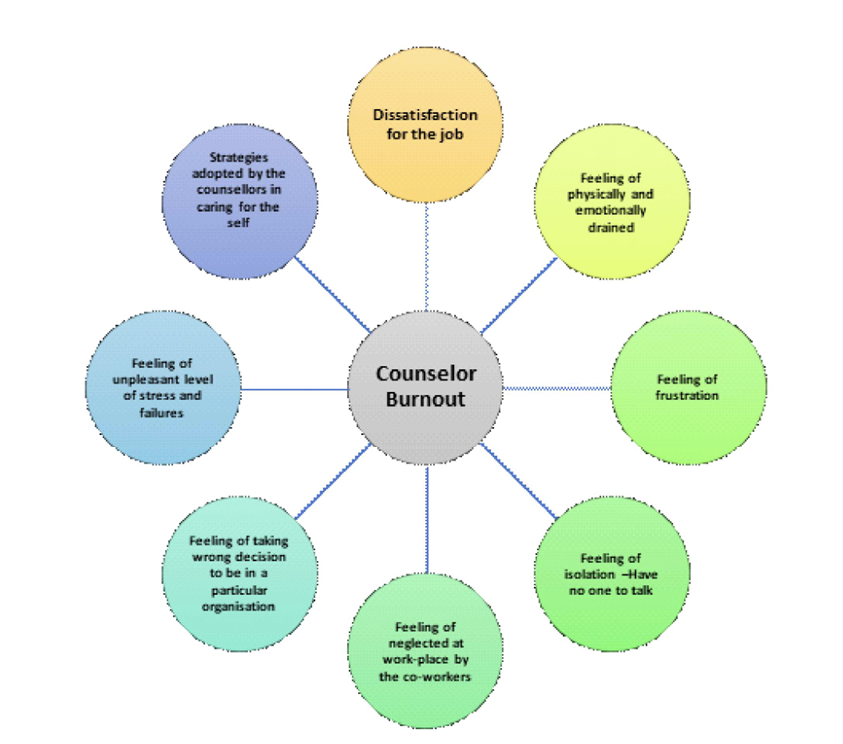
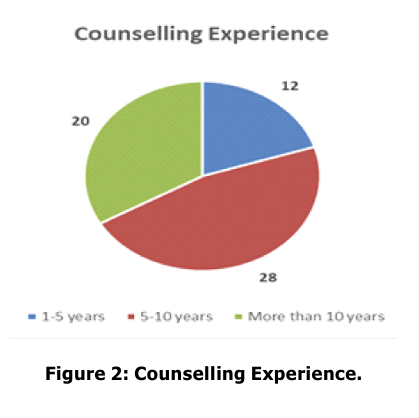
Figure 2 depicts the data on the experience of counsellors in counselling. The findings reflected that 20/60 respondents were practicing counselling for more than 10 years, 28/60 respondents were practicing counselling for the past 5 years, while 12 respondents were practicing counselling for the past 2 years.
The respondents were asked whether they were happy with their job or not, and the level of dissatisfaction. Most of the respondents (45/60) stated that there was a feeling of dissatisfaction. They did not see a correlation between the level of their work and the satisfaction they achieved from that work. The reasons cited by them reflected that too much of a case load, being engaged in too much paperwork, and technology made a few things easy, but it also increased the work pressure. One of the respondents said, “Easy access to WhatsApp messages connected the client with the counsellors, making the counselling process easy, but that created a lot of tension in the life of a counsellor. It was difficult to practice saying no to clients for WhatsApp messages.“ Feeling of physically and emotionally drained The feeling of physical and emotional exhaustion arises when someone is stressed and unable to manage their personal and work life. The person faced burnout, and their level of patience decreased. They did not like to spend time with friends and family. They experienced irritation all the time. The respondents (36/60) of the study revealed that many times they experienced irritation and did not like to talk to anyone. They felt apathy and did not enjoy the company of friends and family. In a study conducted by Schaufeli et al. (2023), Counsellors complained of fatigue, mental exhaustion, and disturbed thoughts to an extent that they could not manage their emotions properly in daily routine tasks and interactions. Another study conducted by Awa et al. (2010) analysed how stress related to counselling work affects counselors’ emotional and physical health. However, it is not necessary that the same stress would cause burnout.
A person may experience the feeling of frustration when they constantly do not perform well and achieve something. The respondents (24/60) stated that sometimes they felt frustrated and confused. They experienced forgetfulness, difficulty in concentration, and loss of memory. Other respondents (36/60) did not experience such health issues as they were engaged in regular exercise and physical fitness.
When someone encounters stress, the feeling of loneliness and isolation emanates naturally. Physical and emotional exhaustion affected the relationship with the family members and also with friends. The respondents (30/60) of the study expressed their limited ability to maintain relationships with their family members and friends. They experienced that they had no one to talk to and share their life challenges. They felt that no one wanted to maintain a social relationship with them. The respondents faced low self-esteem and a lack of zeal to do any work. One of the respondents cited, “A few years back, I felt lonely, that was my problem, and I did not speak to anyone about it. I doubted that the family members liked me, and I had to help myself. The negative feeling of loneliness overpowered me many times, I constantly tried to fight against the feeling of isolation.”
The feeling of being neglected/ignored at the workplace was traumatic for many people. Was the feeling of neglect by the co-workers genuine, or was the manipulation of one’s own thoughts a matter of concern? It was important to have a feeling of job satisfaction and job involvement. The respondents (27/60) agreed that they had experienced ignorance by their teammates on many occasions. They talked to the people who mistreated them or did not talk much with them at the workplace. But nothing changed; they had experienced the feeling of neglect by their co-workers.
The feeling of working with the wrong organisation arises when someone faces low self-esteem and a low level of confidence. Many times, one felt that they were in the wrong profession. The study’s respondents (30/60) felt that they had faced this problem of being in the wrong organisation, as it was very difficult for them to manage their personal and work life efficiently. Few of them (15/60) said that they tried to leave the job, but because of financial insecurities, they did not leave the job. One of the respondents stated, “Being the single earner in the family, he could not take the decision to change the organisation or leave the job.” In a study conducted by Turner and Rankine (2024), it was found that counsellors were unintentionally unable to recognize the symptoms of burnout faced by them. As a result, self-care has also been neglected. The study pointed out that personal as well as organizational factors created chaos in the life of the counsellors, which resulted in burnout being faced by the counsellors, recognized at a very late stage.
Feeling of Stress and failures were associated. Increased work demands at the workplace lead to interpersonal conflicts, feelings of being ostracized, and mistreatment by teammates. The respondents (24/60) shared that workplace mistreatment shattered their confidence. They had faced the physical and emotional fatigue. Many times, they had difficulty falling asleep. And some of them (9/ 60) said they had overslept the day and night. One of the respondents said, “When we were not able to complete the tasks, some of the staff members made mockery, which gave a bad feeling and sense of hopelessness.” Feeling of Stress and failures were associated. Increased work demands at the workplace lead to interpersonal conflicts, feelings of being ostracized, and mistreatment by teammates. The respondents (24/60) shared that workplace mistreatment shattered their confidence. They had faced the physical and emotional fatigue. Many times, they had difficulty falling asleep. And some of them (9/ 60) said they had overslept the day and night. One of the respondents said, “When we were not able to complete the tasks, some of the staff members made mockery, which gave a bad feeling and sense of hopelessness.”
Dealing with physical and emotional exhaustion was very important. People experiencing physical and emotional exhaustion underwent a significant conflict between their personal and work lives. They needed to take care of their physical and emotional energy level and recharge them on time. The respondents were asked to suggest strategies to be adopted by the counsellors for caring for themselves. The respondents (45/60) highlighted the fact that increased work pressure resulted in i ncreased stress and caused job dissatisfaction. Hence, the respondents suggested being assertive in saying no to overwork and taking too many extra assignments. However, the counsellors (36/ 60) revealed that increased case-loads were not under their control. However, they suggested that for the digital (computer-data entry) work, a helping hand could be given to the counsellors. One of the respondents commented, “The task of counselling a client was okay, but doing the entry of counselling data in the computer made us tired.” All the respondents suggested being cautious to maintain their physical and emotional energy levels. They said that the client and counsellor both needed to understand the value of regular exercise and meditation. The present study reflected that the respondents who were engaged in regular exercise and physical fitness did not experience any difficulty. Hence, it stressed that physical exercises also help maintain mental health. It was also recommended by the respondents (45/60) that vacations were essential to spend time with family and friends and to have some rest. In order to reduce the level of stress, time management was needed. If a person were organized with their daily activities, personal and professional, it would reduce their stress level. The respondents (36/60) realized that spending time for weekly leisure activity was again of an utmost importance. One could paint, read, garden, play musical instruments, watch movies, go on a picnic, and spend time with pets. Maintaining social relationships was highlighted as vital by many respondents (42/ 60). They stated that no one can live happily in isolation. A healthy and positive relationship with the team workers should be encouraged. Working in cooperation and coordination with the team members reduced the stress. The feeling of frustration triggers many associated health problems like aggression, depression, and anxiety. The respondents (48/ 60) reflected on the necessity to take care of their emotional intelligence. Recognizing and noticing the feeling and understanding that the feelings were fleeting, so need to respond appropriately and empathetically. The respondents (30/60) responded that they understand the value of active mindfulness exercises, but practicing to live in the present moment was difficult because of multi-tasking job requirements. In a study conducted by Hardiman and Simmonds (2012), self-care was expressed as one of the difficult tasks by the counsellors. They found it difficult to balance the equilibrium of caring for themselves while caring for clients. While another study conducted by Patsiopoulos and Buchanan (2011) stressed the need for better self-awareness and observing the physical and emotional changes and challenges the counselors face. They said that enjoying nature and doing breathing exercises or muscle relaxation exercises were some mindfulness activities, but it was tough to practice. However, counsellors must take time out of their busy schedules for mindfulness activities. The respondents suggested that some time period should be dedicatedly allotted in their job profiles for the relaxation exercise.
REFERENCES
Conflict of interest: None
Role of funding source: None
